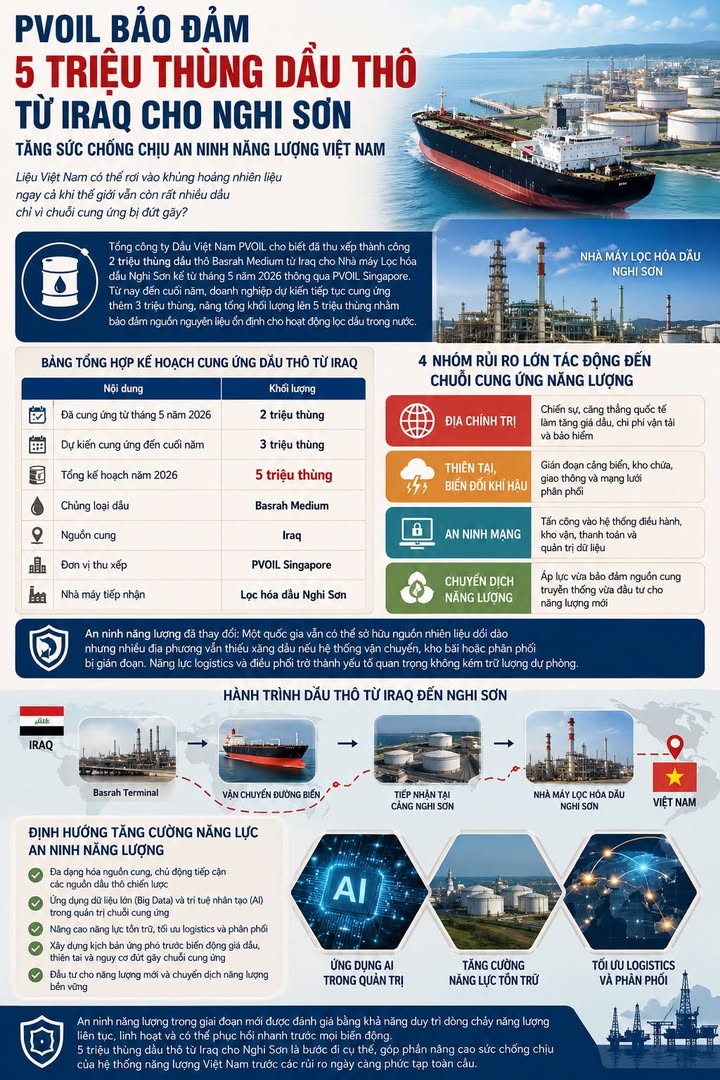
PVOIL Secures 5 Million Barrels of Iraqi Crude for Nghi Sơn: Enhancing Vietnam's Energy Resilience
In an increasingly volatile global energy landscape, Vietnam is taking proactive steps to strengthen its energy security. The Vietnam Oil Group (PVOIL) has successfully arranged a comprehensive supply agreement ensuring 5 million barrels of Basrah Medium crude oil from Iraq for the Nghi Sơn Refinery and Petrochemical LLC (Nghi Sơn). This strategic move represents a significant advancement in Vietnam's efforts to build a resilient energy infrastructure capable of withstanding global disruptions.
The agreement, formalized at a national energy security seminar on July 22, 2023, outlines a phased approach to securing Vietnam's energy future. Under this arrangement, PVOIL Singapore will facilitate the delivery of 2 million barrels of Iraqi crude oil starting from May 2026, with an additional 3 million barrels to be supplied by the end of the same year, bringing the total annual commitment to 5 million barrels.
Shifting Paradigms in Energy Security
"Can Vietnam face a fuel crisis even when the world still has abundant oil simply because supply chains are broken?" This question, raised during the energy security seminar, encapsulates the modern challenges of energy management. According to PVOIL leadership, the greatest challenge today is no longer merely securing adequate oil supplies, but maintaining continuous energy flow amid simultaneous pressures from geopolitical tensions, natural disasters, cybersecurity threats, and the ongoing energy transition.
PVOIL emphasized that the concept of energy security has fundamentally evolved. A nation may possess abundant fuel resources yet still experience localized shortages if transportation, storage, or distribution systems are compromised. This paradigm shift highlights the critical importance of logistics capabilities and coordination, factors now considered as vital as strategic reserves in ensuring energy security.
Strategic Supply Agreement Details
The comprehensive supply agreement between PVOIL and Iraqi oil producers represents a significant diversification of Vietnam's energy import sources. The following table outlines the key components of this strategic arrangement:
| Parameter | Details |
|---|---|
| Total Volume (2026) | 5 million barrels |
| Initial Supply (from May 2026) | 2 million barrels |
| Additional Supply (by end of 2026) | 3 million barrels |
| Crude Type | Basrah Medium |
| Source Country | Iraq |
| Arranging Entity | PVOIL Singapore |
| Receiving Facility | Nghi Sơn Refinery and Petrochemical LLC |
Identifying and Addressing Key Risk Factors
As part of their comprehensive energy security strategy, PVOIL has identified four major risk groups that directly impact energy supply chains. Each category presents unique challenges that require specialized mitigation approaches:
| Risk Group | Primary Impacts |
|---|---|
| Geopolitical | Wars and international tensions increasing oil prices, transportation costs, and insurance premiums |
| Natural Disasters & Climate Change | Disruption of seaports, storage facilities, transportation networks, and distribution infrastructure |
| Cybersecurity | Attacks on operational systems, warehousing infrastructure, payment processing, and data management platforms |
| Energy Transition | Simultaneous pressure to maintain traditional energy supply while investing in new energy infrastructure |
Geopolitical Considerations and Supply Diversification
Within the geopolitical risk category, PVOIL highlighted several specific concerns that could impact Vietnam's energy security. Developments in the Middle East, tensions between the United States and Iran, and the ongoing Russia-Ukraine conflict all pose potential threats to oil import routes and supply stability.
The strategic decision to source Iraqi crude oil directly addresses these concerns by diversifying import sources and reducing dependency on any single region or transportation route. This multi-pronged approach ensures that disruptions in one area can be compensated by increased supplies from other sources, maintaining overall system resilience.
Cybersecurity: The Invisible Threat to Energy Security
Particularly noteworthy is PVOIL's emphasis on cybersecurity risks as a critical component of modern energy security. The company disclosed that it has previously experienced cybersecurity incidents, viewing these experiences as valuable lessons in building more robust defense systems.
"When our entire storage, operational, transportation, and payment systems operate on digital platforms, a single cyberattack could potentially halt fuel distribution across wide areas if proper backup systems and contingency plans are not in place," explained a PVOIL representative. This acknowledgment underscores the growing importance of cybersecurity in maintaining energy infrastructure integrity.
Technological Solutions: Big Data and AI in Energy Management
Complementing their physical supply diversification efforts, PVOIL is investing heavily in technological solutions to enhance supply chain management. The company is developing advanced systems that leverage big data analytics and artificial intelligence to:
- Optimize inventory management and storage capacity
- Enhance logistics efficiency and transportation routing
- Develop predictive models for oil price fluctuations
- Create scenario planning tools for natural disaster response
- Build rapid response frameworks for supply chain disruptions
These technological initiatives represent a forward-looking approach to energy management, enabling more precise forecasting, rapid decision-making, and adaptive responses to changing conditions.
Redefined Metrics for Energy Security
The most significant insight from PVOIL's energy security strategy is the redefinition of how energy security should be measured. Traditionally, energy security has been assessed based on the volume of strategic reserves or the scale of domestic production capabilities.
PVOIL's approach shifts this paradigm, arguing that true energy security in the modern era is measured by a nation's ability to maintain continuous, flexible, and rapidly recoverable energy flows. The 5 million barrel agreement with Iraqi producers exemplifies this new perspective—focusing not just on securing resources, but on ensuring the reliable, uninterrupted delivery of those resources to end-users.
Conclusion: Building a Resilient Energy Future
The comprehensive agreement between PVOIL and Iraqi oil producers represents more than just a commercial transaction; it is a strategic investment in Vietnam's energy resilience. In a world where energy security is increasingly threatened by complex, interconnected challenges, Vietnam's approach offers a valuable model for other nations.
By diversifying supply sources, investing in technological solutions, acknowledging emerging risks, and redefining success metrics, Vietnam is building an energy system capable of withstanding global disruptions. The 5 million barrel Iraqi crude oil commitment to the Nghi Sơn refinery stands as a concrete example of how strategic planning and proactive risk management can enhance national energy security in an uncertain world.
As global energy markets continue to evolve, Vietnam's comprehensive approach to energy security—balancing physical supply with technological innovation and risk management—may well become the standard by which other nations measure their own energy resilience.