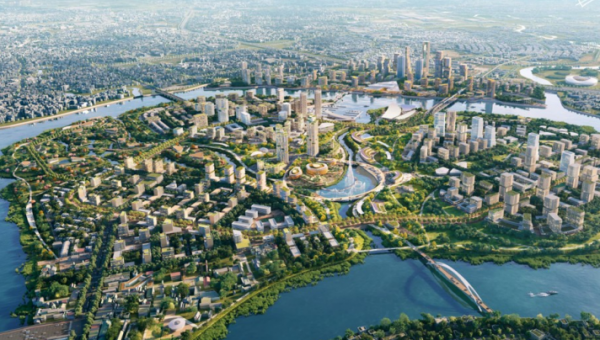
Ho Chi Minh City to Launch $3.74 Billion Urban Development Project
Ho Chi Minh City is preparing to implement the Binh Quoi Thanh Da New Urban Area project with a total investment of over VND 98,710 billion (equivalent to $3.74 billion), promising to become one of the largest-scale urban projects in the city.
Project Overview
The Binh Quoi Thanh Da New Urban Area is planned over a vast area of more than 423 hectares, stretching along the Sai Gon River, creating a green, modern, and classy living space. This is considered a key project in the city's urban development strategy for the coming period.
Scale and Planning
According to the approved planning, the urban area will include:
- 23,000 diverse land plots and apartments
- Modern, synchronized infrastructure system
- Parks, green spaces, sports areas, public amenities
- Bustling commercial and service areas
- Standard schools and hospital systems
Investment and Economic Scale
With a total investment of over VND 98,710 billion ($3.74 billion), Binh Quoi Thanh Da will become one of the largest urban projects in Ho Chi Minh City. The project is not only an ideal residential place but also an important driving force for the city's socio-economic development.
Investment Allocation
| Investment Category | Percentage (%) | Description |
|---|---|---|
| Technical Infrastructure | 35% | Transportation, electricity, water, drainage systems |
| Construction Works | 40% | Apartments, houses, public buildings |
| Amenity Development | 15% | Parks, sports areas, commercial zones |
| Contingency and Management | 10% | Contingency costs, project management |
Housing and Population
The project is expected to accommodate approximately 54,000 people, with diverse housing types from premium to mid-range. Notably, the urban area allocates land for developing 5,867 social housing units, contributing to solving the housing problem for low-income people and workers in Ho Chi Minh City.
Diverse Housing Types
- Commercial townhouses
- Premium apartments
- Mid-range apartments
- Attached houses
- Social housing
Strategic Location
The Binh Quoi Thanh Da urban area is located in a prime location, adjacent to central districts and with convenient transportation connections. This location not only brings high value to real estate but also creates favorable conditions for commuting and connecting to other areas in the city.
Transportation Connection System
- Main roads: Hanoi Highway, National Highway 1A
- Bridge system: Binh Trieu Bridge, Thu Thiem Bridge
- Waterway: Connected by boat
- Future metro system
Impact on Urban Development
The emergence of the Binh Quoi Thanh Da urban area is expected to create positive impacts on Ho Chi Minh City's urban development:
- Solving the housing problem for residents
- Reducing pressure on the central area
- Creating momentum for socio-economic development
- Improving living quality for residents
- Environmental protection and sustainable development
Implementation Timeline and Development Plan
The Binh Quoi Thanh Da New Urban Area project is divided into multiple implementation phases, with the first phase expected to begin this year and be completed within 5-7 years. The entire project is expected to be completed in about 10-15 years.
Detailed Implementation Roadmap
| Phase | Timeline | Main Tasks |
|---|---|---|
| Phase 1 | 2023-2028 | Complete infrastructure, build social housing |
| Phase 2 | 2028-2033 | Build commercial, service areas, premium apartments |
| Phase 3 | 2033-2038 | Complete public works, landscape |
Conclusion
The Binh Quoi Thanh Da New Urban Area project, with an investment scale of over $3.74 billion, is not only the largest urban project in Ho Chi Minh City but also a symbol of the city's modern, sustainable urban development in the future. The project promises to create an ideal living space, a new economic center, and contribute significantly to the city's development process.
The implementation of this project also demonstrates the city government's strong commitment to attracting private investment and developing urban areas in a modern, smart, and sustainable direction.