New Jersey Launches Next-Generation Nuclear Power Program with Minimum 1,100 MW Target
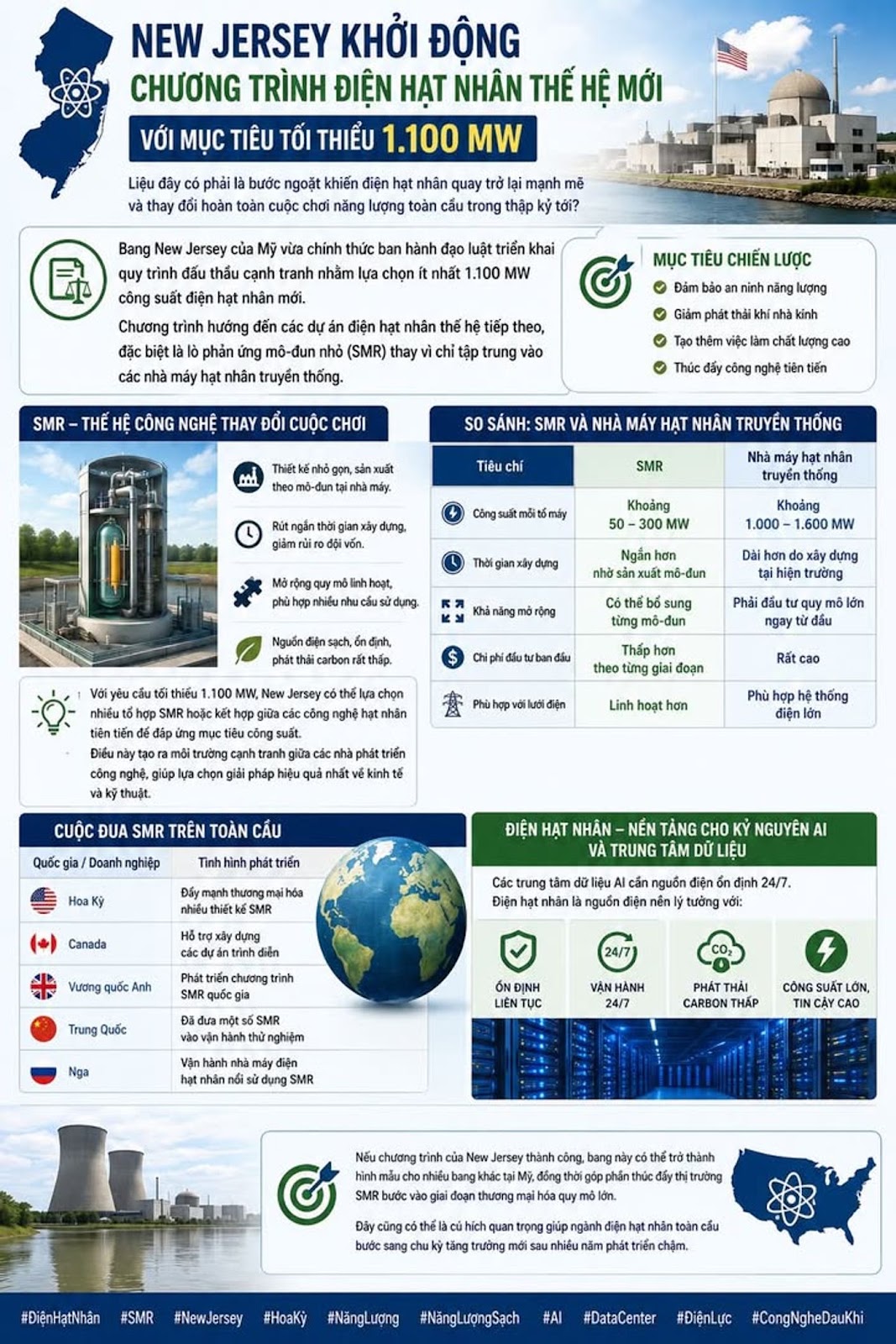
In a move that could potentially reshape the global energy landscape, the state of New Jersey has officially initiated a groundbreaking program for next-generation nuclear power, setting a minimum target of 1,100 megawatts (MW). The legislation establishes a competitive bidding process to select developers for new nuclear capacity, with a particular focus on advanced Small Modular Reactors (SMRs) rather than traditional large-scale nuclear plants.
This ambitious undertaking represents one of the most significant state-level initiatives in the United States to drive the nuclear power renaissance amid rapidly growing electricity demands driven by artificial intelligence, data centers, electric vehicles, and the broader electrification of the economy.
The SMR Revolution: Transforming Nuclear Energy
Small Modular Reactors are emerging as a transformative technology in the nuclear industry, offering a more flexible and scalable approach to nuclear power generation. Unlike traditional nuclear facilities that require massive upfront investments and lengthy construction periods, SMRs feature compact designs that can be manufactured in modules at a factory and then transported to installation sites.
This modular approach offers several key advantages:
- Reduced construction timelines through prefabrication
- Lower capital investment risks through phased deployment
- Greater scalability through the ability to add modules as needed
- Enhanced safety features inherent in many SMR designs
- Flexibility in siting, including locations unsuitable for larger reactors
Comparing SMRs and Traditional Nuclear Power Plants
The following table provides a detailed comparison between Small Modular Reactors and traditional nuclear power plants across key technical and economic parameters:
| Criteria | SMRs | Traditional Nuclear Plants |
|---|---|---|
| Capacity per unit | 50 to 300 MW | 1,000 to 1,600 MW |
| Construction time | Shorter due to modular manufacturing | Longer due to on-site construction |
| Scalability | Can add modules incrementally | Requires large-scale investment from start |
| Initial investment | Lower per phase | Very high upfront costs |
| Grid compatibility | More flexible for various grid sizes | Better suited for large electrical systems |
New Jersey's Strategic Energy Vision
With a minimum requirement of 1,100 MW, New Jersey's program allows for multiple SMR units or a combination of advanced nuclear technologies to meet the target capacity. This competitive approach is designed to foster innovation while ensuring the most economically and technically efficient solutions are selected.
The initiative aligns with several critical objectives:
- Expanding clean energy generation to meet climate goals
- Enhancing energy security through diverse domestic energy sources
- Reducing greenhouse gas emissions from the power sector
- Creating high-quality jobs in advanced technology sectors
- Providing reliable baseload power to support electrification
The Global SMR Race
New Jersey's program is part of a broader international push toward SMR development. The following table highlights key countries and companies advancing SMR technology:
| Country or Company | Development Status |
|---|---|
| United States | Accelerating commercialization of multiple SMR designs |
| Canada | Supporting construction of demonstration projects |
| United Kingdom | Developing national SMR program framework |
| China | Several SMRs in trial operation phase |
| Russia | Operating floating nuclear power plants using SMR technology |
The AI and Data Center Connection
One of the most significant drivers for nuclear power resurgence is the explosive growth in electricity demand from artificial intelligence and data centers. These facilities require continuous, reliable power 24/7—a capability that intermittent renewable sources like wind and solar struggle to provide without extensive energy storage systems.
Nuclear power offers several advantages for meeting these demands:
- Baseload generation with minimal carbon emissions
- Operational continuity regardless of weather conditions
- High power density in a small physical footprint
- Long operational lifetimes (60-80 years) for stable long-term planning
Economic and Environmental Benefits
The integration of advanced nuclear technology into New Jersey's energy portfolio promises substantial economic and environmental benefits. Beyond job creation in high-tech manufacturing and engineering, the program could position the state as a leader in clean energy innovation.
Environmentally, nuclear power provides a zero-carbon source of baseload electricity that can complement intermittent renewables. This combination is increasingly recognized as essential for deep decarbonization of the energy sector while maintaining grid reliability and economic competitiveness.
Implications for the Future of Energy
If New Jersey's nuclear power program succeeds, it could serve as a model for other states and potentially accelerate the commercialization of SMR technology globally. The program's emphasis on competitive bidding and technological innovation may drive down costs while improving performance and safety standards.
This initiative could mark the beginning of a new growth cycle for the global nuclear industry after years of relatively slow development. The combination of policy support, technological advancement, and growing demand for clean, reliable power appears to be creating favorable conditions for nuclear power's renaissance.
As the world seeks to balance growing energy demands with climate imperatives, New Jersey's commitment to next-generation nuclear technology may prove to be a pivotal moment in the transition toward a sustainable energy future.