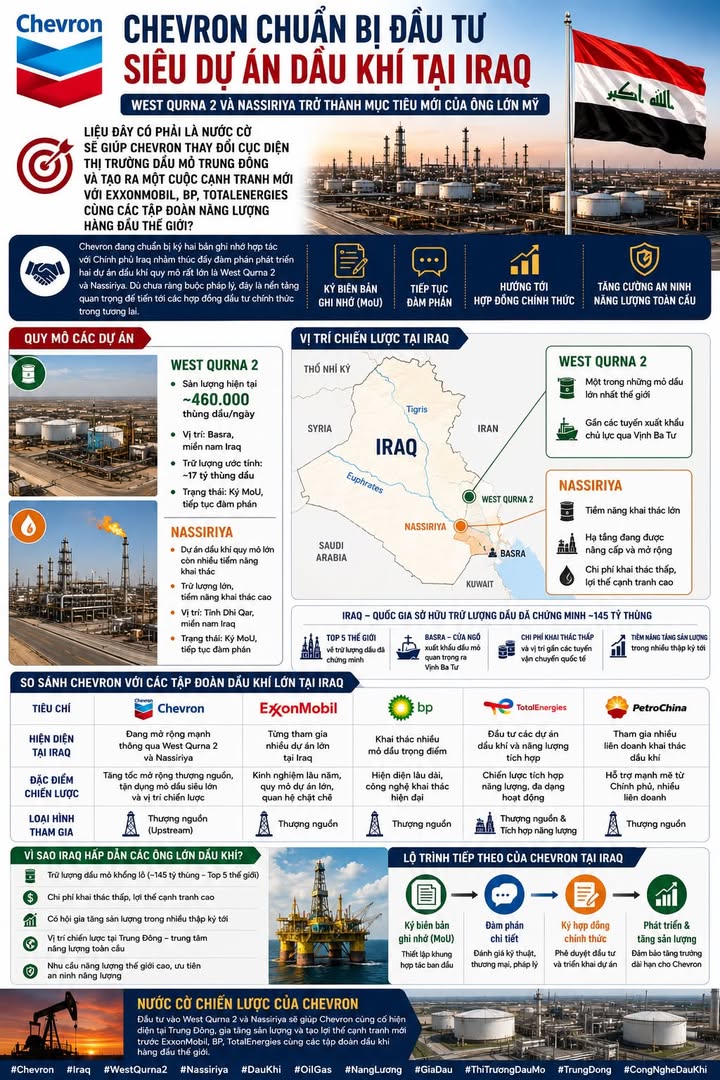
Chevron's Strategic Expansion: Preparing Major Investment in Iraqi Oil Projects
In a move that could reshape the competitive dynamics of the Middle Eastern oil market, Chevron is preparing to sign memoranda of understanding with the Iraqi government to develop two massive oil and gas projects: West Qurna 2 and Nassiriya. This significant expansion represents a strategic pivot for the American energy giant as it seeks to strengthen its presence in a region holding the majority of the world's proven hydrocarbon reserves.
Strategic Significance of Iraqi Operations
The potential investment marks a crucial step in Chevron's strategy to expand its upstream operations globally. By targeting both West Qurna 2 and Nassiriya, Chevron aims to establish itself as a dominant player in Iraq's oil sector, which remains one of the most attractive regions for global oil and gas companies due to its low extraction costs, enormous reserves, and potential for production growth over several decades.
"If these negotiations succeed, this could represent one of Chevron's largest upstream investments in recent years," noted energy analyst Michael Thompson. "The company would be securing long-term production assets in a politically stable part of the Middle East with significant growth potential."
West Qurna 2: A Cornerstone Asset
West Qurna 2 stands as one of the world's largest oil fields, located in southern Iraq's Basra province. After Iraq regained full control of the field earlier this year, current production is maintained at approximately 460,000 barrels of oil per day. The field's development potential remains substantial, with estimates suggesting it could produce significantly more with proper investment and technological implementation.
The project represents not just a production opportunity but also a strategic foothold in the heart of the oil-rich Middle East. Chevron's technical expertise and financial resources could unlock additional reserves and optimize production efficiency at the mature field.
Nassiriya: Emerging Strategic Opportunity
Alongside West Qurna 2, the Nassiriya project presents another strategic opportunity for Chevron. While details remain limited, Nassiriya is understood to be a substantial oil and gas development with significant untapped potential. The development of this field would complement Chevron's existing portfolio and provide additional production capacity in the region.
The simultaneous pursuit of both projects demonstrates Chevron's comprehensive approach to expanding its Iraqi operations, potentially creating a substantial production hub that could position the company as a leading international operator in the country.
Competitive Landscape in Iraqi Energy Sector
Chevron's potential expansion in Iraq comes amid intensifying competition among global energy majors seeking to establish or strengthen their positions in the Middle Eastern oil market. The region's vast reserves continue to attract significant investment despite global energy transition trends.
The following table provides a comparison of major international oil companies and their current presence in Iraq:
| Company | Presence in Iraq | Key Projects | Production Share |
|---|---|---|---|
| Chevron | Expanding through West Qurna 2 and Nassiriya | West Qurna 2 (pending), Nassiriya (pending) | Minimal (pending expansion) |
| ExxonMobil | Historically significant | West Qurna 1 | Approx. 460,000 bpd |
| BP | Major operator | Rumaila, Halfaya | Approx. 800,000 bpd |
| TotalEnergies | Strategic partnerships | Qayyarah, Siba | Approx. 200,000 bpd |
| PetroChina | Significant participation | Halfaya, Ahdab | Approx. 300,000 bpd |
Strategic Implications for Global Oil Markets
Chevron's potential investment in these Iraqi projects carries significant implications for global oil markets. The company's increased presence would enhance Iraq's role as a critical supplier to global markets, particularly as many other regions face natural production declines or political uncertainties that constrain output.
The following table summarizes the key characteristics of Chevron's targeted projects in Iraq:
| Project | Location | Current Status | Production Capacity | Strategic Value |
|---|---|---|---|---|
| West Qurna 2 | Basra Province, Southern Iraq | Under Iraqi control, seeking international operator | Current: ~460,000 bpd Potential: Significantly higher | Immediate production scale, established infrastructure |
| Nassiriya | Nassiriya Province, Central Iraq | Early development stage | To be determined | Long-term growth potential, diversification of assets |
Market Dynamics and Competitive Positioning
The entry or expansion of major players like Chevron in Iraq intensifies competition among international oil companies seeking to secure access to the country's vast resources. This competition could benefit Iraq through improved terms, technological advancement, and increased production efficiency.
"Chevron's move signals confidence in Iraq's long-term production potential," explains energy economist Dr. Sarah Jenkins. "In a world where many conventional oil basins are maturing, Iraq's supergiant fields offer some of the best opportunities for maintaining and increasing global oil supplies."
Broader Context in Global Energy Transition
Chevron's expansion in Iraq occurs against the backdrop of the global energy transition, where many oil companies are balancing conventional investments with growing renewable portfolios. For Chevron, maintaining and expanding conventional oil and gas assets provides the revenue necessary to fund its transition strategy, which includes investments in carbon capture, hydrogen, and other low-carbon technologies.
"The company's ability to generate strong cash flows from conventional assets like those in Iraq will be crucial for funding its broader energy transition initiatives," explains industry analyst Robert Chen. "These Iraqi projects could provide the financial foundation for Chevron's longer-term strategy to evolve into an integrated energy company."
Geopolitical Considerations
From a geopolitical perspective, Chevron's increased presence in Iraq strengthens the economic ties between the United States and Iraq at a time when the country seeks to rebuild its economy and infrastructure following decades of conflict. The investment also positions Chevron advantageously in a region where energy security remains a critical concern for many nations.
Future Outlook
If Chevron successfully negotiates and implements these projects, the company would significantly enhance its position in the global oil market. The West Qurna 2 and Nassiriya developments could collectively represent one of the company's largest upstream portfolios outside of North America, providing substantial production volumes and revenue for decades to come.
Moreover, successful execution in Iraq would demonstrate Chevron's ability to operate effectively in complex international environments, strengthening its reputation as a capable operator of large-scale oil and gas projects worldwide.
As global energy demand continues to evolve, Chevron's strategic positioning in Iraq may prove increasingly valuable, providing the company with both immediate production volumes and a foundation for long-term growth in an energy landscape that will remain dominated by oil and gas for the foreseeable future.
The coming months will be critical as Chevron and Iraqi officials work to finalize the memoranda of understanding and progress toward potentially binding investment agreements. Energy markets worldwide will be watching closely as this strategic development unfolds, with significant implications for both the competitive dynamics of the oil industry and the future of Iraq's energy sector.