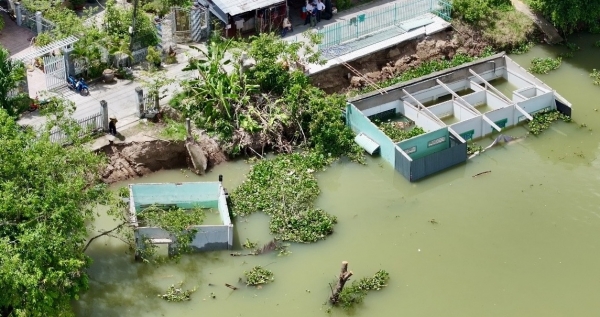
Land Subsidence and Riverbank Erosion in the Mekong Delta: Effective Prevention Instead of Patching Riverbanks
The Mekong Delta - Vietnam's "rice basket" - is facing serious risks of land subsidence and riverbank erosion. This issue is no longer just a matter of natural phenomena but is the result of numerous anthropogenic factors. Dr. Trần Hữu Hiệp, an expert in the Mekong Delta's economy, has analyzed the root causes and proposed fundamental solutions to protect the future of this fertile region.
Background on Land Subsidence and Riverbank Erosion in the Mekong Delta
The Mekong Delta, with an area of approximately 3,964,000 hectares, is Vietnam's largest river delta and one of the most important deltas in the world. This region contributes about 50% of the country's food production, 65% of aquatic products, and 70% of fruits. However, in recent years, the Mekong Delta has been facing a serious challenge from land subsidence and riverbank erosion.
According to the latest research, the Mekong Delta is subsiding at an average rate of 1-3 cm/year, with some areas reaching up to 5 cm/year. This rate is 3-5 times higher than the global average sea-level rise. The riverbank erosion situation is also becoming increasingly severe, causing the loss of thousands of hectares of agricultural land and affecting the lives of millions of people.
Analysis of Root Causes by Dr. Trần Hữu Hiệp
In his in-depth analysis, Dr. Trần Hữu Hiệp points out that the root causes of the problem stem not only from natural phenomena but primarily from human activities:
- Construction of dams on the upper Mekong: The construction of numerous dams on the main stream of the Mekong River has altered natural water flow, reducing the amount of sediment reaching the delta.
- Excessive groundwater extraction: Activities extracting groundwater for agricultural production and daily living have lowered groundwater levels, leading to land subsidence.
- Inappropriate construction works: The construction of concrete anti-erosion structures has changed local water flow patterns, causing erosion in adjacent sections.
- Land use changes: The conversion of mangrove forests and rice paddies to irrigation works and industrial zones has reduced the land's ability to retain soil and prevent erosion.
- Climate change: Rising sea levels combined with high tides have increased riverbank erosion, particularly in coastal areas.
Fundamental Solutions Instead of "Patching" Riverbanks
According to Dr. Trần Hữu Hiệp, instead of continuing with temporary, "patchwork" solutions for riverbanks, fundamental, systematic solutions are needed:
1. Integrated Water Resource Management
A comprehensive water resource management mechanism needs to be established for the entire Mekong River basin, ensuring the participation of all countries in the region. There should be a gradual reduction in groundwater extraction, shifting to more efficient surface water use.
2. Restoration of Natural Ecosystems
Restoring and protecting natural ecosystems such as mangrove forests, coastal protective forests, and natural wetlands. These ecosystems have a natural ability to prevent erosion and landslides that is far superior to constructed works.
3. Application of Advanced Technology
Using GIS and remote sensing technologies to monitor and accurately predict areas at high risk of subsidence and erosion. Implementing advanced construction technologies such as soft dike technology and using environmentally friendly local materials.
4. Adjustment of Land Use Planning
Adjusting land use planning to suit natural conditions, especially in areas at high risk of subsidence and erosion. Restricting the development of critical infrastructure in vulnerable areas.
5. Enhancement of Community Awareness
Strengthening communication to raise community awareness about the risks of subsidence and erosion, encouraging people to participate in prevention and adaptation activities to climate change.
Potential Socio-Economic Impacts Without Effective Solutions
Without fundamental and timely solutions, the Mekong Delta will face severe consequences:
| Sector | Potential Impact |
|---|---|
| Agriculture | Loss of agricultural land, reduced rice productivity, decreased biodiversity, impact on food security |
| Aquaculture | Loss of aquaculture area, freshwater salinization, reduced catch volume |
| Transportation | Damage to roads and bridges, increased maintenance and repair costs |
| Urban Areas | Flooding, damage to infrastructure, impact on residents' livelihoods |
| Population | Livelihood affected, migration, loss of housing, resource conflicts |
Conclusion
The phenomenon of land subsidence and riverbank erosion in the Mekong Delta is a significant challenge that requires urgent attention and decisive action from all levels of government, experts, and the community. Instead of continuing with temporary, "patchwork" solutions for riverbanks, fundamental, long-term solutions based on scientific analysis and practical experience are needed.
Dr. Trần Hữu Hiệp emphasizes: "The Mekong Delta is a valuable national asset, the country's 'rice basket.' Protecting the Mekong Delta is not only the responsibility of the agricultural sector but the responsibility of society as a whole. We need a long-term vision, inter-sectoral coordination, and community participation to protect the future of this fertile land."
Only with comprehensive and decisive solutions can we protect the Mekong Delta from the risks of subsidence and erosion, ensuring sustainable development for this important region.