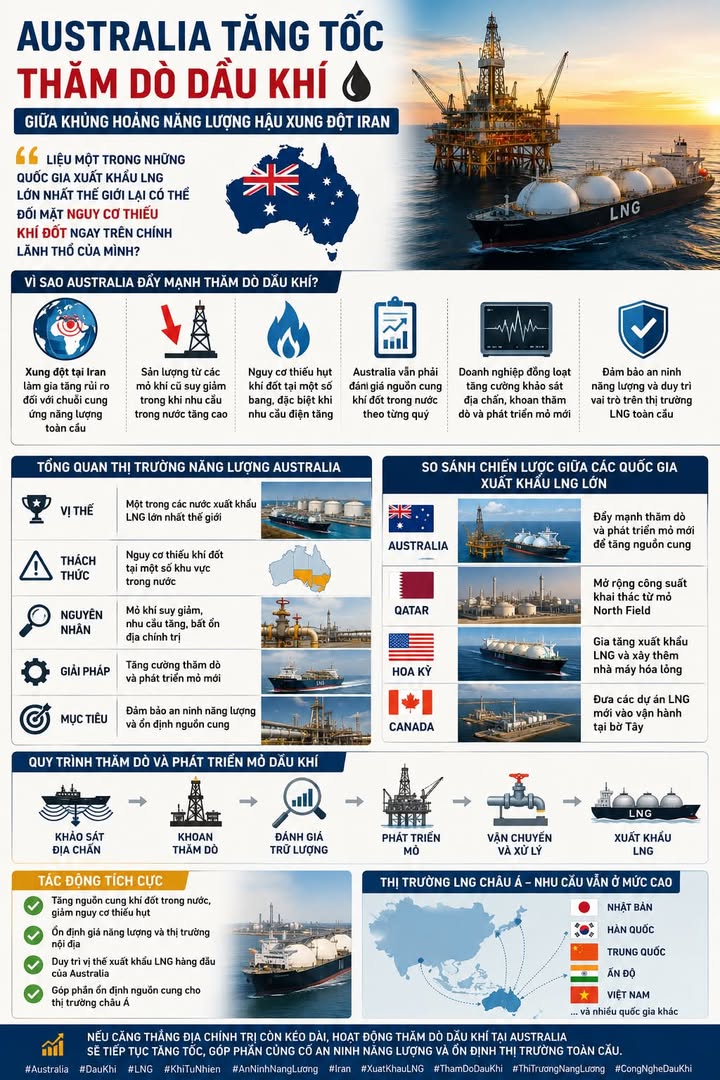
Australia Accelerates Oil and Gas Exploration Amid Global Energy Crisis
In an unexpected twist of fate, one of the world's largest exporters of liquefied natural gas (LNG) is facing potential domestic gas shortages, prompting a significant acceleration in oil and gas exploration activities. As geopolitical tensions in the Middle East continue to disrupt global energy markets, Australia is taking proactive measures to secure its energy future while maintaining its position as a critical energy supplier to Asian markets.
The Global Energy Context: Post-Iran Conflict Landscape
The recent escalation of conflict in Iran has sent shockwaves through global energy markets, disrupting supply chains and causing significant price volatility. This geopolitical instability has highlighted the fragility of global energy systems and the critical importance of energy security for nations worldwide.
For Australia, a country heavily integrated into the global LNG market, these developments have created both challenges and opportunities. While the nation possesses vast natural resources, the convergence of declining domestic production, increasing demand, and international uncertainty has created a complex energy landscape that demands strategic responses.
Australia's Energy Position: Strengths and Vulnerabilities
Australia stands as one of the world's premier LNG exporters, with established infrastructure and markets across Asia. However, this position masks underlying vulnerabilities in the domestic energy market that have become increasingly apparent in recent years.
Regulatory authorities conduct quarterly assessments of domestic gas supply, consistently identifying potential shortfalls in several states. These warnings have grown more urgent as demand for electricity rises and production from aging gas fields continues to decline. The situation presents a paradox: a resource-rich nation confronting potential domestic energy shortages.
| Australia's Energy Market Overview | |
|---|---|
| Global Position | One of the world's largest LNG exporters |
| Domestic Challenge | Potential gas shortages in several regions |
| Primary Causes | Declining production from mature fields, increasing demand, geopolitical instability |
| Strategic Response | Accelerated exploration and development of new resources |
The Intersection of Geopolitics and Energy Security
The Middle East energy crisis has served as a stark reminder of how geopolitical events can rapidly transform energy markets. For Australia, which has historically benefited from stable energy exports, this new reality has necessitated a reevaluation of energy security strategies.
"The events in Iran have demonstrated that no country is immune to global energy disruptions," explains Dr. Eleanor Carter, energy security analyst at the Australian Institute of Strategic Policy. "While Australia has been fortunate in maintaining export capabilities, we cannot ignore the domestic implications of these international tensions."
Industry Response: Accelerating Exploration Activities
In response to these challenges, Australia's oil and gas sector has embarked on an ambitious expansion of exploration activities. Major companies are securing new permits, expanding seismic surveys, and drilling exploratory wells at an accelerated pace.
This industry-wide effort represents a significant investment in Australia's energy future, with companies targeting both conventional and unconventional gas resources. The objective is twofold: to increase domestic production and to maintain Australia's competitive position in the global LNG market.
Technology and Innovation in Exploration
The renewed focus on exploration has coincided with technological advancements that are revolutionizing the oil and gas sector. Advanced seismic imaging techniques, improved drilling technologies, and enhanced data analytics are enabling companies to identify and develop resources more efficiently than ever before.
"We're seeing a convergence of technologies that make exploration more precise and cost-effective," says James Mitchell, CEO of Australian Energy Resources. "These technological advancements are crucial as we work to bring new resources online to meet both domestic and international demand."
Comparative Analysis: Global LNG Export Strategies
Australia's approach to addressing energy security challenges can be understood in the context of global LNG export strategies. Different nations are pursuing various paths to maintain and expand their market positions in an increasingly competitive environment.
| Major LNG Exporting Nations | Current Strategic Focus |
|---|---|
| Australia | Accelerating exploration and development of new gas fields to increase supply |
| Qatar | Expanding production capacity from the North Field, the world's largest non-associated gas field |
| United States | Increasing LNG export volumes and constructing additional liquefaction facilities |
| Canada | Bringing new LNG projects online on the west coast to access Asian markets |
Domestic Energy Security: A Priority for Policy and Industry
The acceleration of oil and gas exploration in Australia reflects a growing recognition that energy security must be a central consideration in both policy and industry planning. The government has indicated support for expanded exploration while simultaneously emphasizing the need for orderly development that balances economic, environmental, and social considerations.
"Energy security is fundamental to our national prosperity and well-being," said Minister for Resources and Energy, Amanda Johnson. "We're committed to supporting responsible development of our resources to ensure Australia can meet both domestic needs and maintain our position as a reliable supplier to international markets."
Regional Implications for Asian Markets
As the world's largest importer of LNG, Asia's energy security is closely tied to Australia's production capabilities. Japan, South Korea, and other Asian economies rely heavily on Australian LNG to fuel their industrial and residential sectors.
The acceleration of exploration in Australia is expected to help stabilize LNG supplies to these markets, particularly if geopolitical tensions in the Middle East persist. This regional dimension adds another layer of strategic importance to Australia's domestic energy policies.
Future Outlook: Balancing Competing Priorities
Looking ahead, Australia's oil and gas sector faces the challenge of balancing competing priorities: increasing domestic production, maintaining export competitiveness, addressing environmental concerns, and transitioning toward lower-emission energy sources.
Industry analysts suggest that the current acceleration in exploration represents a medium-term strategy to address immediate energy security concerns. Longer-term, Australia is expected to continue developing its gas resources while simultaneously investing in carbon capture technologies and exploring pathways to hydrogen production.
The Path Forward
As geopolitical tensions continue to shape global energy markets, Australia's approach to oil and gas exploration will likely remain a key factor in both domestic and international energy security. The nation's ability to develop its resources responsibly while maintaining economic competitiveness will determine its future position in the evolving global energy landscape.
"The current situation presents both challenges and opportunities for Australia," concludes Dr. Carter. "By leveraging our technological capabilities and strategic location, we can enhance our energy security while continuing to play a vital role in meeting global energy demand."
The acceleration of oil and gas exploration in Australia represents a significant development in the global energy sector, reflecting how nations are adapting to an increasingly complex and uncertain geopolitical environment. As the world navigates the aftermath of the Iran conflict and other energy market disruptions, Australia's approach may serve as a model for balancing domestic energy needs with international market responsibilities.