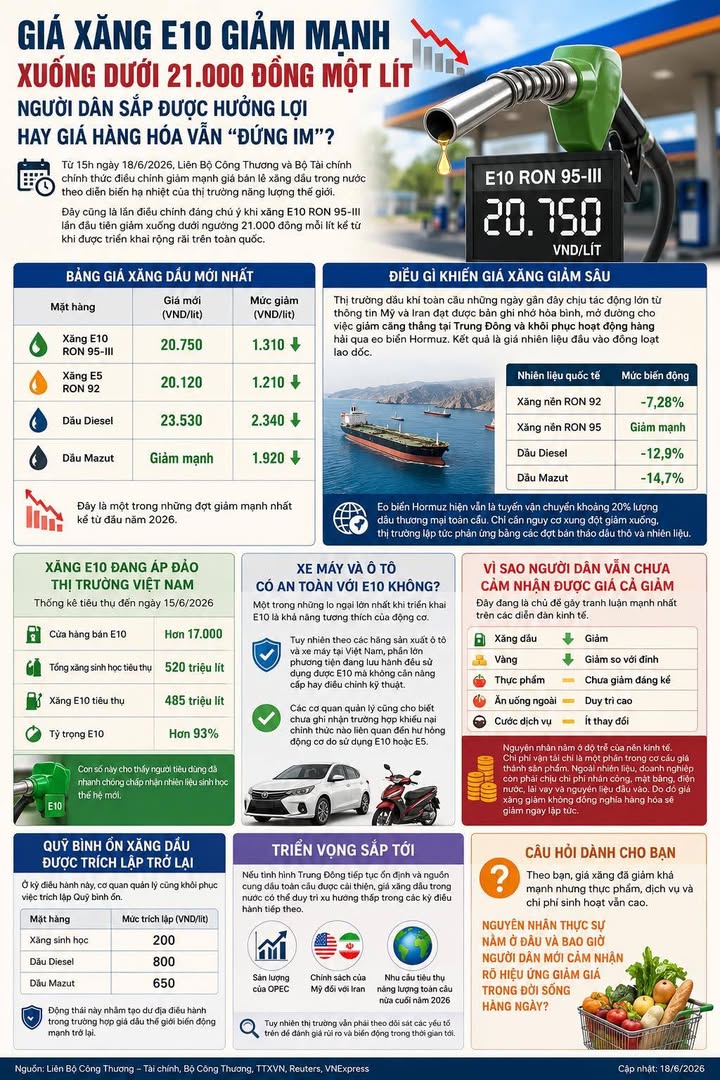
Vietnam's Gasoline Prices Drop Sharply, with E10 Falling Below 21,000 VND per Liter
In a significant move that impacts millions of Vietnamese citizens, the Ministry of Industry and Trade, in coordination with the Ministry of Finance, has implemented substantial reductions in retail gasoline prices nationwide effective 3:00 PM on June 18, 2026. This adjustment marks a notable moment as E10 RON 95-III gasoline drops below the 21,000 VND per liter threshold for the first time since its widespread implementation across the country.
Unprecedented Price Reduction
The latest price adjustment represents one of the most significant decreases since the beginning of 2026. Consumers are witnessing considerable relief at the pump, with all major fuel products experiencing notable price reductions.
| Fuel Type | New Price (VND/liter) | Reduction Amount (VND) |
|---|---|---|
| E10 RON 95-III | 20,750 | 1,310 |
| E5 RON 92 | 20,120 | 1,210 |
| Diesel | 23,530 | 2,340 |
| Mazut | Reduced significantly | 1,920 |
Global Market Influences
The substantial price reduction is primarily attributed to significant shifts in the global energy market. Recent developments indicate that the United States and Iran have reached a memorandum of understanding aimed at fostering peace, potentially easing tensions in the Middle East and facilitating the restoration of maritime activities through the Strait of Hormuz.
This geopolitical development has triggered a notable downturn in international fuel prices, with input fuels experiencing synchronized declines:
| International Fuel Type | Price Fluctuation |
|---|---|
| RON 92 Base Gasoline | -7.28% |
| RON 95 Base Gasoline | Significant decrease |
| Diesel | -12.9% |
| Mazut | -14.7% |
The Strait of Hormuz remains a critical transportation route, handling approximately 20% of global commercial oil traffic. Any reduction in geopolitical tensions in the region prompts immediate market reactions, often resulting in significant sell-offs of crude oil and refined products.
E10's Market Dominance in Vietnam
Following more than two weeks of nationwide implementation, E10 gasoline has demonstrated remarkably rapid adoption rates. Statistical data on consumption up to June 15, 2026, reveals impressive market penetration:
| Indicator | Value |
|---|---|
| Number of E10-selling stations | Over 17,000 |
| Total biofuel consumption | 520 million liters |
| E10 consumption | 485 million liters |
| E10 market share | Over 93% |
These statistics indicate that consumers have quickly embraced the next-generation biofuel, reflecting successful implementation and acceptance of Vietnam's energy transition strategy.
Vehicle Compatibility with E10
One of the primary concerns during E10 implementation was engine compatibility. However, according to automotive and motorcycle manufacturers in Vietnam, the vast majority of vehicles currently in circulation can utilize E10 without requiring technical upgrades or modifications.
Regulatory authorities have also reported no official complaints regarding engine damage attributed to E10 or E5 usage, further confirming the fuel's compatibility with existing vehicle fleets.
The Consumer Paradox: Why Aren't Prices Dropping Everywhere?
Despite the significant reduction in gasoline prices, many consumers question why they haven't observed corresponding decreases in everyday goods and services. This discrepancy has become a topic of intense debate across economic forums.
| Expense Category | Current Trend |
|---|---|
| Gasoline & Diesel | Decreasing |
| Gold | Decreasing from peak |
| Food Products | Minimal decrease |
| Dining Out | Remains high |
| Service Fees | Limited change |
The explanation lies in the nature of economic lag within the supply chain. Transportation costs constitute only one component of product pricing structures. Businesses must also manage labor expenses, commercial rent, utilities, loan interest rates, and raw material costs. Consequently, gasoline price reductions do not immediately translate to lower commodity prices.
Resumption of the Price Stabilization Fund
In this pricing adjustment period, regulatory authorities have also reinstated the establishment of the Price Stabilization Fund, creating a buffer for future market interventions:
| Fuel Type | Stabilization Fund Contribution (VND/liter) |
|---|---|
| Biofuels | 200 |
| Diesel | 800 |
| Mazut | 650 |
This measure aims to provide regulatory flexibility in case of significant reversals in global oil prices, ensuring market stability and preventing extreme price volatility.
Future Outlook
If the situation in the Middle East continues to stabilize and global oil supply improves, domestic gasoline prices in Vietnam may maintain their downward trend in subsequent adjustment periods. However, the market requires close monitoring of several critical factors:
- OPEC production levels and output policies
- United States policy toward Iran and its potential impact on oil exports
- Global energy consumption demand in the second half of 2026
- Geopolitical developments in oil-producing regions
Conclusion
While Vietnam has experienced substantial gasoline price reductions, the full impact on consumer prices remains a work in progress. The relationship between fuel prices and broader economic indicators involves multiple variables and time lags that prevent immediate transmission of cost savings to end consumers.
As the market continues to evolve, the successful transition to E10 biofuel demonstrates Vietnam's commitment to sustainable energy solutions, while the price adjustments reflect both global market dynamics and domestic economic policy priorities. The ultimate benefit to consumers will likely manifest gradually as businesses adjust their pricing strategies to reflect the new cost structures.