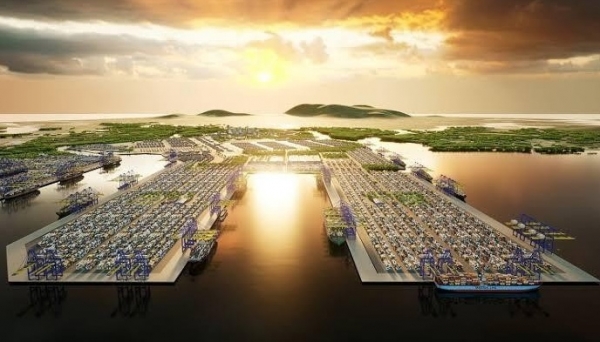
Ho Chi Minh City Establishes Over 4,170-Ha Free Trade Zone Linked with Cai Meo Ha Port
In a strategic move aimed at promoting maritime economy, logistics, and international trade, the People's Committee of Ho Chi Minh City has officially issued a decision to establish a Free Trade Zone (FTZ) linked with the Cai Meo Ha sea port area, covering an impressive scale of over 4,170 hectares.
Background and Strategic Significance
The establishment of the Free Trade Zone at Cai Meo Ha marks a significant milestone in Ho Chi Minh City's maritime economy development strategy. This initiative represents a new growth driver, not only serving the city but also contributing to the economic development of the Southeast region and the country as a whole.
Cai Meo Ha has been identified as one of the most important deep-water ports in Vietnam, capable of accommodating vessels with large cargo capacities. Linking the free trade zone with this port creates a complete logistics ecosystem, from seaport to industrial zones and commercial areas, reducing costs and enhancing logistics efficiency.
Scale and Geographical Location
The Cai Meo Ha Free Trade Zone spans approximately 4,174 hectares, extending across the districts of Nha Be, Cu Chi, and Binh Chanh. This strategic location is situated near major transportation arteries such as National Highway 51, National Highway 22, and the Ho Chi Minh City - Long Thanh - Dau Giay expressway, creating favorable conditions for connectivity with major economic centers both domestically and internationally.
Specifically, the area includes:
- The Cai Meo - Thi Vai port area covering approximately 1,200 hectares
- The logistics and services area covering approximately 1,500 hectares
- The urban service and commercial area covering approximately 1,474 hectares
Special Incentive Policies
The Cai Meo Ha Free Trade Zone will apply special incentive policies to attract domestic and foreign investment. These policies include:
| Incentive Type | Detailed Contents |
|---|---|
| Corporate Income Tax | 10% tax rate for 15 years, 4-year tax exemption, 50% tax reduction for the next 9 years |
| Import Tax | Exemption for imported goods for export production, imported goods from abroad into the free trade zone |
| Value Added Tax (VAT) | 0% tax rate for exported goods and services and other services as prescribed |
| Personal Income Tax | 10% tax rate for individuals working in the free trade zone |
Expected Economic Impact
The emergence of the Cai Meo Ha Free Trade Zone is expected to have profound economic impacts:
- New Growth Driver: Expected to contribute approximately 5-7% to the GDP of Ho Chi Minh City and the Southeast region
- Investment Attraction: Expected to attract about 10-12 billion USD in investment in the next 5 years
- Job Creation: To create approximately 100,000-150,000 direct and indirect jobs
- Infrastructure Development: Promote investment in transportation, seaport, and logistics infrastructure
- Competitive Enhancement: Enhance Vietnam's position in regional and global supply chains
Development Plan for 2023-2030
According to the plan, the Cai Meo Ha Free Trade Zone will be developed in phases:
| Phase | Timeline | Main Objectives |
|---|---|---|
| Phase 1 | 2023-2025 | Complete planning, attract key investment projects, build basic infrastructure |
| Phase 2 | 2026-2028 | Complete technical infrastructure, develop functional zones, attract large enterprises |
| Phase 3 | 2029-2030 | Complete the free trade zone, operate stably, become a regional logistics center |
Reactions from Experts and Businesses
Economic experts have highly evaluated this decision by Ho Chi Minh City, considering it a necessary step to enhance Vietnam's competitiveness in the context of deep international integration.
According to Mr. Nguyen Van Dao, a maritime economy expert: "The Cai Meo Ha Free Trade Zone will be an important link in the Southeast Asian supply chain. With the advantage of a deep-water port and attractive incentive policies, this area will attract major global logistics and trade corporations."
Many domestic and foreign businesses have expressed significant interest in this project. A representative of an international logistics group stated: "We highly appreciate this decision by Ho Chi Minh City and are in the process of studying investment opportunities in this potential area."
Challenges and Solutions
Besides the opportunities, the Cai Meo Ha Free Trade Zone also faces several challenges:
- Transportation Infrastructure: Need to complete the transportation system connecting the area with the center of Ho Chi Minh City and neighboring provinces
- Human Resources: Train high-quality human resources to meet the requirements of the free trade zone
- Regional Competition: Create competitive advantages compared to other free trade zones in the region
- Legal Framework: Improve the legal framework to create a favorable investment environment
To address these challenges, Ho Chi Minh City has proposed comprehensive solutions, focusing on improving infrastructure, training human resources, administrative procedure reform, and building flexible and effective management mechanisms.
Conclusion
The establishment of the Cai Meo Ha Free Trade Zone with its large scale and special incentive policies is a strategic decision by Ho Chi Minh City, opening up new development opportunities for the maritime economy, logistics, and international trade. With thorough preparation and strong political determination, this area is expected to become an important growth driver, contributing to making Ho Chi Minh City a regional and global economic, financial, and logistics center.
#HoChiMinhCity #FreeTradeZone #CaiMeoHa #Logistics #MaritimeEconomy #InternationalTrade #SoutheastRegion