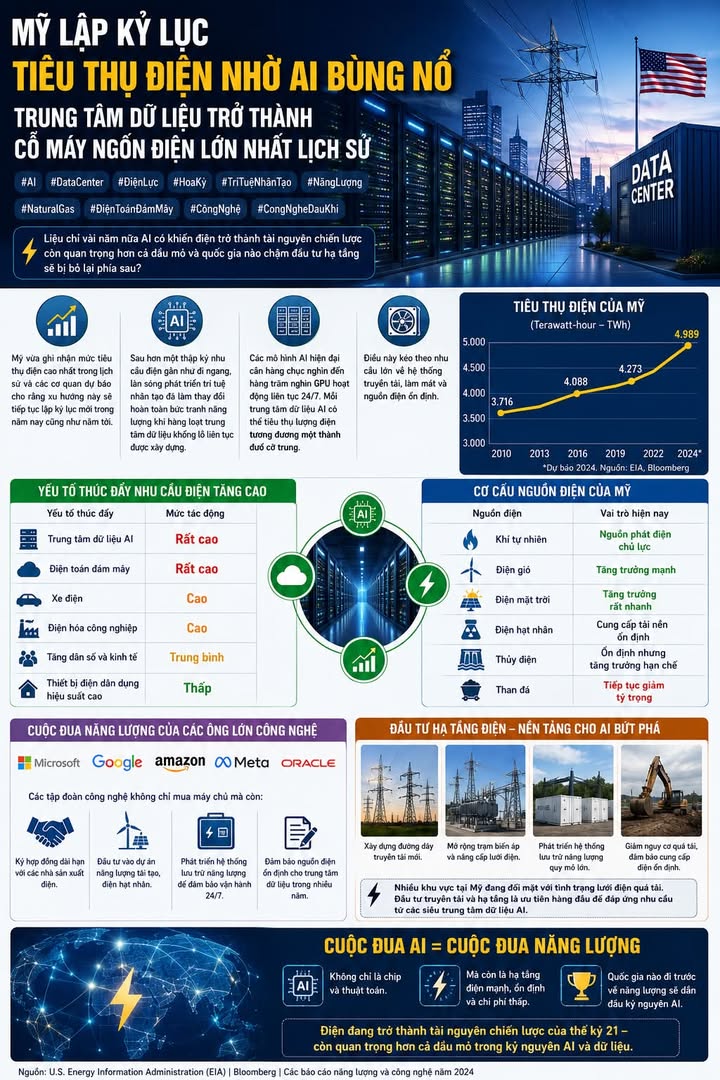
The United States has recently recorded its highest electricity consumption in history, with projections indicating this trend will continue to set new records in the current and following years. After more than a decade of relatively stagnant electricity demand, the wave of artificial intelligence development has completely transformed the energy landscape as massive data centers continue to be constructed to serve next-generation AI models.
## The Energy Transformation Fueled by Artificial Intelligence
For years, energy efficiency improvements, enhanced device performance, and economic structural shifts helped keep America's electricity demand growth minimal. However, the emergence of generative AI, cloud computing, and hyperscale data centers has caused electricity consumption to surge dramatically within a short period.
Modern AI models require tens of thousands to hundreds of thousands of GPUs operating continuously 24 hours a day. A single AI data center can consume an amount of electricity equivalent to a medium-sized city, creating substantial demand for transmission systems, cooling infrastructure, and stable power sources.
### Factors Driving Electricity Consumption in the US Era of AI
| Factor | Impact Level |
|--------|--------------|
| AI Data Centers | Very High |
| Cloud Computing | Very High |
| Electric Vehicles | High |
| Industrial Electrification | High |
| Population and Economic Growth | Medium |
| High-Efficiency Consumer Electronics | Low |
## The Critical Role of Power Sources in the AI Revolution
Notably, despite the continued rapid expansion of renewable energy, natural gas remains America's primary power source due to its ability to provide stable and reliable baseload power. This has led to continued implementation of new natural gas power plant projects to meet the growing demand from AI operations.
| Power Source | Current Role |
|--------------|--------------|
| Natural Gas | Primary power generation source |
| Wind Power | Rapidly growing |
| Solar Power | Very rapid growth |
| Nuclear Power | Provides stable baseload power |
| Hydropower | Stable but limited growth |
| Coal | Continuing to decline in share |
## The Intensifying Competition for Energy Resources
The AI boom has also created fierce competition among major technology corporations such as Microsoft, Google, Amazon, Meta, and Oracle in securing long-term power supplies. Rather than merely purchasing servers, many companies are now signing direct contracts with power producers or investing in renewable energy projects, nuclear power, and energy storage to ensure their data centers can operate for many years to come.
In addition to expanding power generation sources, the US must heavily invest in power transmission infrastructure as many regions face overloaded grid systems. The construction of new transmission lines, substations, and storage systems has become a priority to avoid the risk of localized power shortages when massive AI data centers come online simultaneously.
## The Expanding Dimensions of the AI Race
The AI race has thus evolved beyond mere competition in processing chips or algorithms to include a race for energy resources. Nations with stable, low-cost, and rapidly expandable energy infrastructure will hold significant advantages in attracting investment in AI, cloud computing, and future technology sectors.
As artificial intelligence continues to permeate every aspect of our economy and society, electricity is emerging as a strategic resource potentially more critical than oil. Countries that delay investing in energy infrastructure risk being left behind in the technological revolution that is reshaping our world.
The convergence of AI and energy represents not just a technological challenge but a fundamental shift in how we must think about resource allocation, infrastructure development, and economic competitiveness in the 21st century.