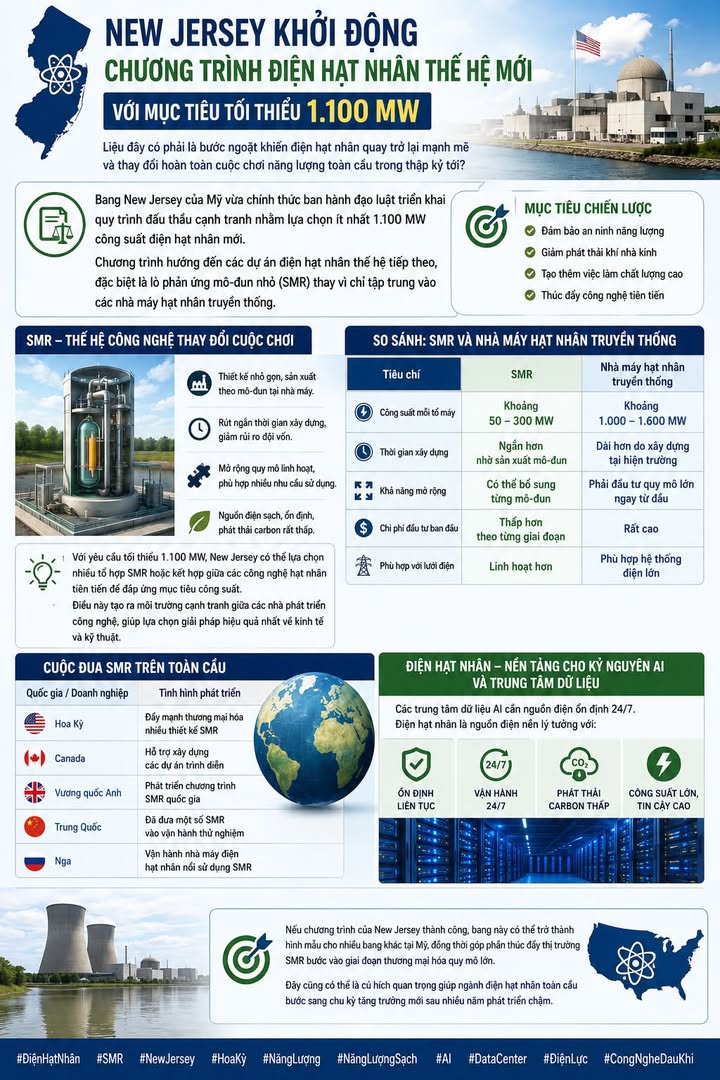
New Jersey Launches Next-Generation Nuclear Energy Program with Minimum 1,100 MW Target
In a move that could signal the renaissance of nuclear power in the United States, New Jersey has officially initiated a groundbreaking program for next-generation nuclear energy. The state has enacted legislation to establish a competitive bidding process aimed at selecting at least 1,100 MW of new nuclear capacity, with a particular focus on advanced small modular reactor (SMR) technology rather than traditional large-scale nuclear plants.
This ambitious undertaking represents one of the most significant state-level initiatives in the nation to promote the resurgence of nuclear energy amid rapidly growing electricity demands driven by artificial intelligence, data centers, electric vehicles, and the broader electrification of the economy.
The New Jersey Nuclear Initiative: Key Details
New Jersey's legislative action establishes a formal framework for competitive bidding to develop new nuclear generation capacity. The program specifically targets next-generation nuclear technologies, with SMRs taking center stage. The state has set a minimum threshold of 1,100 MW, which could be satisfied through multiple SMR units or a combination of advanced nuclear technologies.
By focusing on SMRs, New Jersey aims to leverage the unique advantages of these advanced reactors, including their scalability, reduced construction timelines, and enhanced safety features. The competitive nature of the bidding process is designed to foster innovation while ensuring cost-effectiveness and technical viability.
Small Modular Reactors: Transforming the Nuclear Landscape
Small Modular Reactors represent a paradigm shift in nuclear energy technology. Unlike traditional nuclear power plants that typically generate 1,000-1,600 MW from a single facility, SMRs produce between 50-300 MW per unit. Their modular design allows for factory production of components that can then be transported to the site for assembly, significantly reducing construction time compared to conventional nuclear plants built entirely on-site.
The table below highlights the key differences between SMRs and traditional nuclear power plants:
| Criteria | SMR | Traditional Nuclear Plant |
|---|---|---|
| Capacity per unit | 50 to 300 MW | 1,000 to 1,600 MW |
| Construction time | Shorter due to modular manufacturing | Longer due to on-site construction |
| Scalability | Can add modules incrementally | Large-scale investment required from start |
| Initial investment cost | Lower per phase | Very high |
| Grid compatibility | More flexible | Suitable for large electrical systems |
The advantages of SMR technology extend beyond technical specifications. These reactors offer enhanced safety features through passive cooling systems, reduced financial risk due to phased investment, and greater flexibility in siting options. Their smaller footprint also makes them suitable for locations where traditional nuclear plants would be impractical.
Strategic Objectives of New Jersey's Nuclear Program
Beyond developing clean energy capacity, New Jersey's nuclear initiative serves multiple strategic objectives:
- Enhancing Energy Security: Diversifying the state's energy portfolio with a reliable, domestic power source
- Reducing Greenhouse Gas Emissions: Providing carbon-free baseload power to support climate goals
- Economic Development: Creating high-quality jobs in advanced technology sectors
- Grid Reliability: Ensuring stable power supply to support growing electricity demands
The Global SMR Race
New Jersey's initiative reflects a broader global trend toward SMR development. Nations and companies worldwide are investing in this technology as a pathway to nuclear energy expansion. The table below outlines the current status of SMR development in key regions:
| Country or Company | Development Status |
|---|---|
| United States | Accelerating commercialization of multiple SMR designs |
| Canada | Supporting development of demonstration projects |
| United Kingdom | Developing a national SMR program |
| China | Several SMRs in trial operation |
| Russia | Operating floating nuclear power plants using SMR technology |
The AI and Data Center Connection
One of the most significant drivers behind the renewed interest in nuclear energy is the explosive growth of artificial intelligence and data centers. These facilities require massive amounts of electricity with 24/7 reliability—something that intermittent renewable sources like wind and solar cannot provide without extensive energy storage solutions.
Nuclear power, with its extremely low carbon emissions and constant baseload capability, is increasingly seen as the ideal complement to renewable energy sources for powering AI infrastructure. The ability of SMRs to provide scalable, reliable power makes them particularly well-suited for data center applications.
Potential Impact and Future Outlook
If New Jersey's nuclear program proves successful, it could serve as a model for other states seeking to decarbonize their energy sectors while meeting growing electricity demands. The competitive bidding process may identify the most cost-effective and technically advanced nuclear solutions, potentially accelerating the commercialization of SMR technology nationwide.
The implications extend beyond state borders. A successful implementation in New Jersey could help drive the global nuclear industry into a new growth cycle after years of stagnation. As climate concerns intensify and electricity demand continues to rise, nuclear energy—particularly in the form of advanced SMRs—may play an increasingly critical role in the global energy transition.
New Jersey's initiative represents more than just an energy policy decision; it could mark the beginning of a fundamental shift in how the United States and the world approach clean energy development in the 21st century.