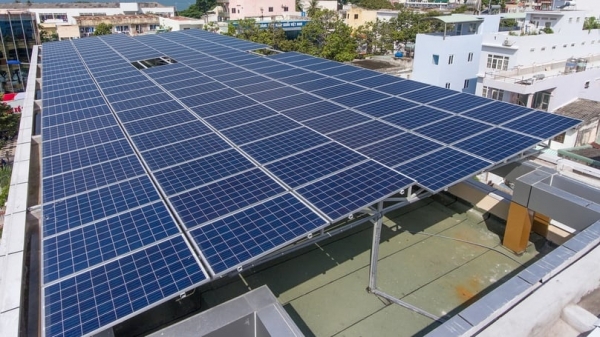
Cà Mau Seeks Solutions to Promote Solar Power Development
In the context of global energy transition and commitments to reduce carbon emissions, Cà Mau province is actively seeking solutions to promote solar power development, particularly rooftop solar systems. This approach is considered a crucial solution to ensure energy security, promote green transition, and develop a circular economy in the region.
Current State of Solar Power Development in Cà Mau
Cà Mau, with its unique geographical location and abundant solar energy potential, has taken initial steps in applying solar technology. However, compared to its potential, the development speed remains slow and not commensurate with the natural advantages of the region.
According to statistics from the Cà Mau Department of Industry and Trade, by the end of 2022, the total solar power capacity in the province reached approximately 150 MW, of which rooftop solar accounted for about 30%. While this shows growth, the figures remain modest compared to the province's actual potential.
Summary of Solar Power Development in Cà Mau
| Indicator | 2021 | 2022 | Growth Rate |
|---|---|---|---|
| Total Capacity (MW) | 120 | 150 | 25% |
| Rooftop Solar Power (MW) | 30 | 45 | 50% |
| Number of Participating Households | 1,200 | 1,800 | 50% |
Solutions to Promote Solar Power in Cà Mau
To accelerate the development of solar power, the Cà Mau Provincial People's Committee has issued an action plan with specific solutions focusing on the following key areas:
- Building incentive mechanisms: Creating favorable conditions for administrative procedures and providing initial financial support for households and businesses installing rooftop solar systems.
- Strengthening communication: Organizing seminars and training sessions to raise awareness about the benefits of solar power and effective installation and operation methods.
- Developing community models: Encouraging cooperatives and residential areas to install collective solar power systems to optimize economic efficiency.
- Attracting investment: Creating a favorable investment environment for large-scale solar power projects combined with other economic activities.
Economic and Environmental Benefits
The development of solar power in Cà Mau brings practical benefits both economically and environmentally:
Economic Benefits
- Reducing electricity costs for households and businesses
- Creating additional revenue from selling excess electricity to the national grid
- Boosting related industries: installation, maintenance, solar power equipment
- Creating jobs for local workers
Environmental Benefits
- Reducing greenhouse gas emissions, contributing to environmental protection
- Reducing dependence on fossil fuels
- Utilizing unlimited clean renewable energy sources
- Contributing to climate change mitigation and sea level rise prevention in the Mekong Delta region
Comparison of Economic and Environmental Benefits of Solar Power
| Field | Benefits | Impact Level |
|---|---|---|
| Economic | Reduced electricity costs, new income sources | High |
| Environmental | Reduced CO2 emissions, cleaner environment | High |
| Social | Job creation, enhanced awareness | Moderate |
Challenges and Solutions
Despite numerous benefits, solar power development in Cà Mau still faces many challenges:
- High initial investment costs: Installation costs for solar power systems remain a barrier for many households.
- Lack of technical expertise: The human resource pool with expertise in installing and operating solar power systems is still limited.
- Inconsistent policies: Mechanisms for selling excess electricity and financial support have not been truly attractive.
- Psychological hesitation: A portion of the population still concerns about safety and system longevity.
To overcome these challenges, Cà Mau is focusing on implementing comprehensive solutions:
- Designing preferential credit packages with low interest rates for households and businesses wanting to install solar power systems.
- Organizing vocational training courses in solar power technology to create high-quality human resources for the locality.
- Improving the legal framework and mechanisms for selling excess electricity at reasonable and transparent prices.
- Building successful pilot models to expand and build community trust.
Vision and Future Direction
According to the plan by 2030, Cà Mau aims to achieve a total solar power capacity of over 500 MW, with rooftop solar accounting for at least 200 MW. To achieve this goal, the province identifies a sustainable development direction for solar power, combined with key economic sectors such as agriculture and fisheries.
Specifically, Cà Mau will focus on developing models that:
- Combine solar power with agriculture (rooftop solar on greenhouses and net houses)
- Combine solar power with aquaculture on water surfaces (float solar)
- Combine solar power with wastewater treatment and environmental management
- Solar power in industrial zones and export processing zones
Conclusion
Promoting solar power development in Cà Mau is not only an urgent solution to ensure energy security but also the right direction in the green transition and circular economy development process. With comprehensive solutions, the involvement of the entire political system, and active participation of the people, Cà Mau can completely become a bright spot in renewable energy application in the Mekong Delta region, contributing to Vietnam's commitments on carbon emission reduction.