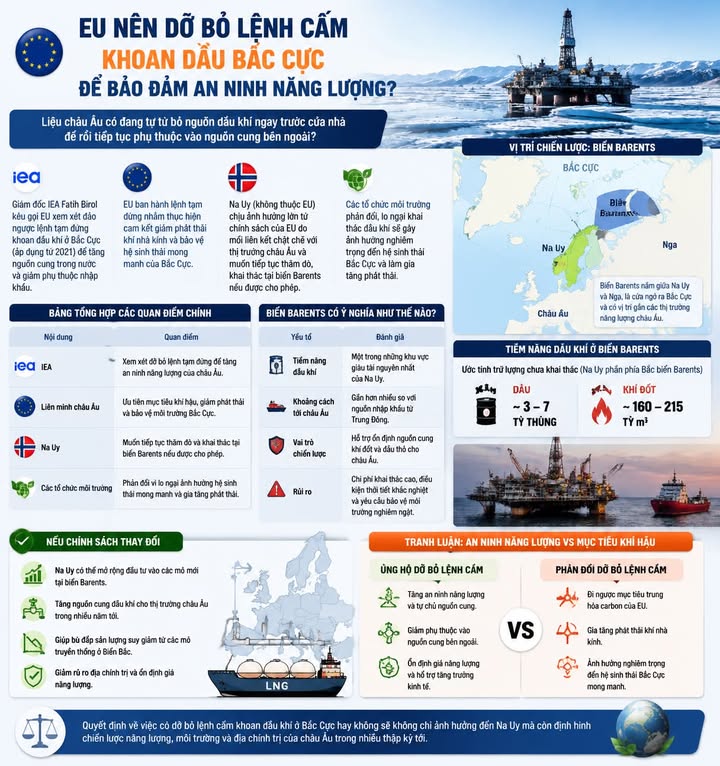
Should the EU Lift Arctic Drilling Ban to Ensure Energy Security?
Is Europe potentially abandoning vital oil and gas resources right at its doorstep while continuing to rely on external supply sources? This question has gained urgency as the International Energy Agency (IEA) calls on the European Union to reconsider its 2021 moratorium on Arctic oil and gas drilling.
In the wake of recent geopolitical upheavals that have highlighted energy security vulnerabilities, the IEA's Executive Director Fatih Birol has suggested that controlled development in the Arctic could help Europe increase domestic energy supplies and reduce import dependency. This recommendation has reignited a complex debate balancing economic needs, environmental concerns, and strategic interests.
The IEA's Perspective on Arctic Energy Development
The IEA's position represents a significant shift in thinking about Arctic energy resources. According to Birol, the Arctic—particularly Norway's portion of the Barents Sea—holds substantial untapped reserves that could contribute to European energy security. The agency argues that in a world where energy supply chains have proven vulnerable to geopolitical tensions, developing domestic resources becomes increasingly important.
"We need to be realistic about our energy needs while accelerating the clean energy transition," Birol stated. "The Arctic resources, if developed with the highest environmental standards, could play a role in this transition by replacing more distant and potentially less secure supplies."
The EU's 2021 Arctic Drilling Moratorium
The European Union implemented its Arctic drilling ban in 2021 as part of broader efforts to reduce greenhouse gas emissions and protect vulnerable Arctic ecosystems. The policy specifically prohibits the expansion of oil and gas activities in Norway's northern Barents Sea region, which is estimated to contain the majority of Norway's remaining untapped hydrocarbon resources.
This moratorium reflects the EU's commitment to its European Green Deal, which aims for climate neutrality by 2050. The policy recognizes that new fossil fuel developments are fundamentally at odds with long-term climate goals, particularly when considering the carbon footprint of extracting resources in such a remote and challenging environment.
Norway's Strategic Position and the Barents Sea
Although not an EU member, Norway remains deeply connected to European energy markets through extensive infrastructure and supply agreements. Oslo has repeatedly expressed its desire to continue exploration and production in the Barents Sea, provided that policy barriers are removed.
The Barents Sea represents one of Norway's most promising remaining petroleum provinces. Its development could provide significant economic benefits while enhancing European energy security through proximity and established logistical networks.
| Barents Sea: Key Strategic Factors | |
|---|---|
| Oil & Gas Potential | One of Norway's most resource-rich offshore areas with significant untapped reserves |
| Proximity to Europe | Significantly closer than traditional supply sources from the Middle East |
| Strategic Value | Could enhance stability of natural gas and crude oil supplies to European markets |
| Development Challenges | High extraction costs, extreme weather conditions, and strict environmental protection requirements |
The Energy Security vs. Climate Imperative Debate
The question of Arctic drilling encapsulates a fundamental tension in contemporary energy policy: how to balance immediate security concerns with long-term climate imperatives. Proponents of Arctic development argue that:
- Developing domestic resources reduces geopolitical risks and price volatility
- Norwegian oil and gas would likely replace imports from less stable regions
- Advanced technologies can minimize environmental impacts
- Revenue could fund further clean energy development
Conversely, environmental organizations and climate advocates emphasize that:
- New fossil fuel development is incompatible with climate goals
- The Arctic ecosystem is particularly vulnerable to industrial activity
- Drilling in extreme environments carries heightened risks of accidents
- Investment should flow to renewables, not extending fossil fuel dependence
| Key Stakeholder Positions on Arctic Drilling | |
|---|---|
| International Energy Agency (IEA) | Advocates for considering lifting the moratorium to enhance energy security while maintaining high environmental standards |
| European Union | Prioritizes climate targets and Arctic environmental protection over new fossil fuel development |
| Norway | Seeks permission to continue exploration and production in the Barents Sea to maintain its energy industry and exports |
| Environmental Organizations | Strongly oppose expansion due to risks to fragile ecosystems and increased greenhouse gas emissions |
Potential Impacts of Policy Changes
If the EU were to modify its position on Arctic drilling, Norway could significantly increase investment in new fields in the Barents Sea. This development could supplement European energy supplies for decades, particularly as traditional fields in the North Sea approach maturity and experience production declines.
Economically, such development would generate substantial government revenue for Norway, create jobs, and potentially lower energy costs in European markets. The proximity of these resources to European markets also reduces transportation costs and carbon footprint compared to imports from more distant regions.
However, these benefits would need to be weighed against environmental considerations. The Arctic ecosystem is exceptionally vulnerable to industrial activity, with potential impacts on biodiversity, indigenous communities, and global climate patterns. The region's sensitivity also means that any accident could have particularly severe consequences.
The Path Forward: Balancing Competing Priorities
The Arctic drilling debate reflects a broader challenge facing Europe and other industrialized regions: how to navigate the complex transition to a low-carbon future while maintaining energy security and economic stability.
Policymakers must consider multiple time horizons—immediate security concerns versus long-term climate commitments—and diverse stakeholders—energy consumers, industry, environmental advocates, and future generations. The Arctic represents just one piece of this larger puzzle, but decisions about its resources could have outsized implications for Europe's energy future.
Whatever path Europe chooses, the decision will likely reverberate beyond Norway, potentially shaping energy strategies across the continent for decades. The Arctic drilling moratorium may ultimately be remembered as either a necessary climate safeguard or a missed opportunity to enhance regional energy security—depending on how the energy transition unfolds and how global geopolitics evolve.
As the world continues to grapple with competing energy priorities, the Arctic stands as both a resource frontier and a climate sentinel—a reminder that our energy choices today will shape the world we inherit tomorrow.