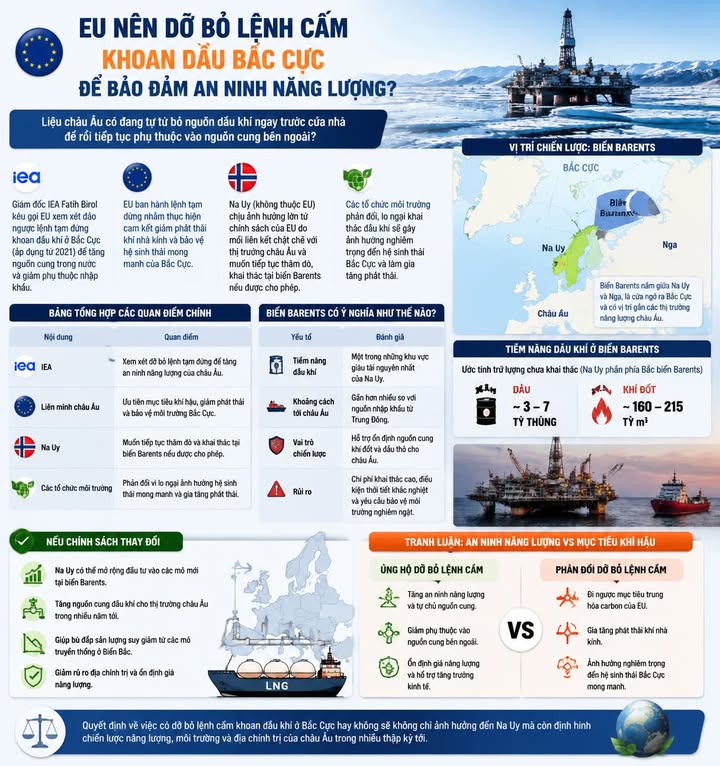
Is Europe abandoning its oil and gas resources right at its doorstep and then continuing to depend on outside supplies?
IEA Executive Director Fatih Birol said that the European Union should consider reversing the moratorium on oil and gas drilling in the Arctic issued since 2021. According to him, in the context of energy security becoming a top priority after many geopolitical fluctuations, controlled exploitation in the Arctic can help Europe increase domestic energy supply and reduce dependence on imports.
The EU's moratorium was put in place to fulfill commitments to reduce greenhouse gas emissions and protect the Arctic ecosystem. This policy does not allow the expansion of drilling activities in Norway's northern Barents Sea area, which is estimated to contain the majority of the country's remaining unexploited oil and gas reserves.
Although not an EU member, Norway is still greatly influenced by the bloc's energy policy due to its close links with the European market. Oslo repeatedly expressed its desire to continuec exploration and exploitation in the Barents Sea if policy barriers are removed.
Table summarizing the main viewpoints
Content Perspectives
IEA Consider lifting moratorium to increase energy security
European Union Prioritizes climate goals and protects the Arctic environment
Norway Wants to continue mining if allowed
Environmental organizations oppose because of concerns about ecological impacts and emissions
What does the Barents Sea mean?
Evaluation Factor
Oil and gas potential One of Norway's most resource-rich regions
Distance to Europe Closer than many sources of imports from the Middle East
Strategic role: Supporting stable gas and crude oil supply
Risks High exploitation costs, harsh weather conditions and strict environmental protection requirements
If policies change, Norway can expand investment in new fields in the Barents Sea, thereby adding more oil and gas supply to the European market for many years to come. This is especially important as many traditional fields in the North Sea are entering a phase of production decline.
However, this decision will certainly cause strong debate. One side believes that exploiting domestic resources will help reduce geopolitical risks and stabilize energy pricesquantity. The other side is concerned that expanding mining in the Arctic will go against carbon neutrality goals, increase emissions and affect one of the world's most fragile ecosystems.
The debate between energy security and emissions reduction goals is becoming a difficult problem for Europe. Future decisions will not only affect Norway but could also shape the energy strategy of the entire region for decades to come.
#EU #Norway #Barents Sea #IEA #OilGas #Gas #EnergySecurity #Arctic #EnergyTransportation #OilGasTechnology