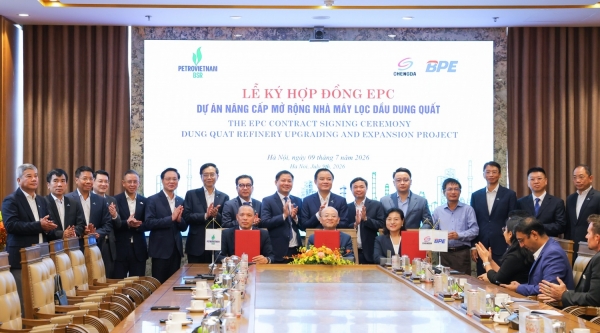
BSR Signs EPC and PMC Contracts for Dung Quat Refinery Expansion Project
On July 9th, in Hanoi, Vietnam Oil and Gas Group Petrovietnam's subsidiary, Binh Son Refinery and Petrochemical Company (BSR), held a ceremony to sign Engineering, Procurement and Construction (EPC) and Project Management Consultant (PMC) contracts for the Dung Quat Refinery Expansion Project. This significant event marks a crucial step in modernizing and enhancing the production capacity of Vietnam's sole oil refinery, contributing to national energy security and promoting socio-economic development.
The ceremony was attended by key industry leaders, government officials, and representatives from the contracting parties, underscoring the project's importance to Vietnam's energy infrastructure and economic future.
Significance of the Dung Quat Refinery Expansion Project
The Dung Quat Refinery Expansion Project represents one of the most significant industrial undertakings in Vietnam's recent history. With a total investment of approximately $2 billion, the project aims to increase the refinery's processing capacity from 6.5 million tons per year to 10 million tons per year. Simultaneously, it will upgrade product quality to meet Euro 5 emission standards, aligning with Vietnam's environmental commitments and international best practices.
The project is scheduled for completion by 2025, with phased implementation to ensure minimal disruption to ongoing operations. Once operational, the expanded facility will help meet the growing domestic demand for petroleum products, reduce dependence on imports, and enhance Vietnam's position in the regional oil refining industry.
EPC and PMC Contracts: Content and Strategic Importance
The EPC contract was awarded to PetroVietnam Construction Corporation (PVC), a leading construction company with extensive experience in Vietnam's oil and gas sector. This comprehensive contract covers all aspects of engineering design, procurement of equipment and materials, and construction of the project's facilities.
The PMC contract was secured from TechnipFMC, a world-leading company in project management consulting for the oil and gas industry based in France. TechnipFMC will provide specialized expertise in project management, quality supervision, schedule assurance, and operational testing support.
The dual-contract structure ensures that both the technical execution and professional management aspects of this complex project receive the highest level of attention and expertise.
| Summary of the Dung Quat Refinery Expansion Project | |
|---|---|
| Project Name | Dung Quat Refinery Expansion Project |
| Investor | BSR (Petrovietnam subsidiary) |
| Total Investment | Approximately $2 billion |
| Design Capacity | Increase from 6.5 million tons/year to 10 million tons/year |
| Product Quality | Compliance with Euro 5 standards |
| Completion Timeline | Expected by 2025 |
| Strategic Importance | Enhance energy security, reduce import dependency, position Vietnam as regional refining hub |
Technical Scope of the Expansion
The expansion will include additional processing units, upgrading of existing facilities, and implementation of advanced technologies to maximize efficiency and product yield. Key components include:
- Construction of new crude distillation units
- Installation of advanced catalytic cracking units
- Implementation of sulfur recovery units to meet environmental standards
- Upgrading of product treatment facilities
- Expansion of storage and loading facilities
- Modernization of utility systems and infrastructure
Challenges and Opportunities
The Dung Quat Refinery Expansion Project faces numerous technical, technological, and management challenges due to its large scale and complexity. The project must integrate new facilities with existing infrastructure while maintaining continuous operations. Additionally, it must incorporate the latest environmental and safety standards while managing budget constraints and timeline pressures.
However, these challenges present significant opportunities for Vietnam's industrial sector. The project will:
- Transfer advanced technologies and expertise to Vietnamese engineers and technicians
- Strengthen domestic supply chains and manufacturing capabilities
- Create thousands of jobs during construction and operation
- Enhance Vietnam's technical capacity in the oil and gas sector
- Position Vietnam as an attractive destination for foreign investment in energy infrastructure
Mr. Nguyen Viet Thang, General Director of BSR, emphasized: "The signing of the EPC and PMC contracts marks a significant milestone, reaffirming BSR and Petrovietnam's commitment to the successful implementation of the Dung Quat Refinery Expansion Project. This project is crucial for ensuring national energy security and sustainable development."
EPC vs. PMC Contracts: Understanding the Difference
To better understand these two critical contract types, here is a detailed comparison:
| Comparison of EPC and PMC Contracts | ||
|---|---|---|
| Criteria | EPC Contract | PMC Contract |
| Definition | Engineering, Procurement, and Construction - turnkey responsibility | Project Management Consulting - advisory and supervisory role |
| Primary Responsibilities | Complete project execution from design to construction and handover | Provide expertise, supervision, management support, and operational assistance |
| Contract Duration | Covers entire project lifecycle | Covers entire project lifecycle with emphasis on critical phases |
| Risk Profile | Bears higher risk for schedule, cost, and quality | Bears risk related to quality of advice and supervision |
| Payment Structure | Typically fixed price with incentives for early completion | Usually time and materials with performance bonuses |
| Key Performance Indicators | On-time completion, within budget, quality standards | Quality of supervision, schedule adherence, risk management |
| Appropriate For | Large-scale greenfield projects or major brownfield expansions | Complex projects requiring specialized technical oversight |
Future Vision and Strategic Impact
The expanded Dung Quat Refinery will not only satisfy domestic energy demands but also create opportunities for exporting petroleum products to regional and international markets. The project is expected to generate thousands of jobs during construction and operation, stimulating local and national economic development.
Furthermore, the refinery's expansion aligns with Vietnam's broader energy strategy, which aims to diversify energy sources, improve efficiency, and reduce carbon emissions. The Euro 5 standard compliance will contribute to cleaner air quality and public health benefits.
BSR and its partners have committed to close collaboration to ensure the project's timely completion, quality assurance, and cost-effectiveness. The successful implementation of this project will position Vietnam as more self-sufficient in energy supply and gradually establish the country as a regional refining center.
Regional Implications
The Dung Quat Refinery Expansion Project will have significant implications for Southeast Asia's energy landscape. By increasing refining capacity, Vietnam can potentially become a net exporter of refined petroleum products, strengthening its economic position in the region. The project also demonstrates Vietnam's commitment to developing its industrial base and reducing reliance on energy imports.
Conclusion
The signing of the EPC and PMC contracts for the Dung Quat Refinery Expansion Project marks a pivotal moment in Vietnam's industrial development. This strategically important investment will enhance the country's energy security, stimulate economic growth, and position Vietnam as a significant player in the regional oil refining industry.
With the expertise of BSR, Petrovietnam, PVC, and TechnipFMC, the project is well-positioned to overcome technical challenges and deliver a world-class facility that will serve Vietnam's energy needs for decades to come. The successful completion of this expansion will represent a major achievement in Vietnam's journey toward industrialization and sustainable development.