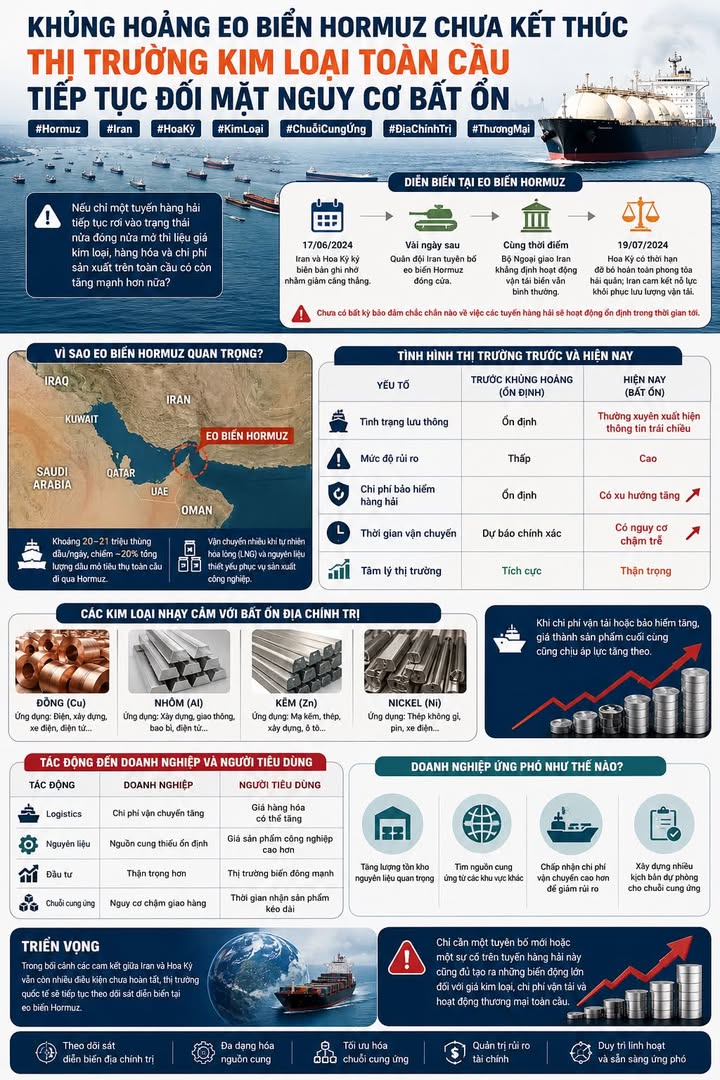
If just one maritime route continues to be half-closed, half-open, will global prices of metals, commodities and production costs increase even more?
Six months after the military campaign Operation Epic Fury upset commodity markets, the Strait of Hormuz remains at the center of international trade instability. Although Iran and the United States signed a memorandum of understanding on June 17 to reduce tensions, conflicting signals continue to appear, making it impossible for businesses and investors to determine the actual situation.
Just a few days after the agreement was signed, the Iranian military announced that the Strait of Hormuz would continue to be closed, while the Iranian Foreign Ministry confirmed that shipping activities were still going on normally. Conflicting statements keep the market's risk assessment at a very high level.
According to the agreement, the United States has until July 19 to completely lift the naval blockade, while the Iranian side only commits to efforts to restore shipping traffic to pre-conflict levels. This means there is noany certainty that maritime routes will operate stably in the near future.
Hormuz is the world's strategic transportation route, not only for oil but also for many raw materials for industrial production. Any disruption could increase logistics costs, lengthen delivery times and put pressure on base metal prices.
Factors Before the Current Crisis
Traffic status Stable Conflicting information often appears
Risk level Low High
Marine insurance costs Stable Tend to increase
Shipping Time Accurate Forecast There is a risk of delay
Market sentiment Positively Cautious
Metallurgical and manufacturing enterprises are having to build many contingency scenarios. Many units increase raw material inventories, source supplies from other regions or accept higher transportation costs to reduce the risk of supply chain disruption.
Some metals such as copper, aluminum, zinc and nickel are particularly sensitive to geopolitical fluctuations because of steady demand in the construction, electric vehicle, electronics and energy sectors. When transportation or insurance costs increase, final product prices also come under increased pressure.
Impact on Businesses and Consumersg
Logistics Increased transportation costs Commodity prices may increase
Raw materials Unstable supply Prices of industrial products are higher
Invest More Cautiously The market fluctuates strongly
Supply chain Risk of delayed delivery Long product receipt time
In the context that commitments between Iran and the United States still have many unfinished conditions, the international market will continue to closely monitor developments in the Strait of Hormuz. Just one new declaration or incident on this maritime route is enough to create major fluctuations in metal prices, shipping costs and global trade activities.
#Hormuz #Iran #United States #Metals #Supply Chain #Logistics #Geopolitics #Trade #World Economy #TimKiemTop