OPEC+ Continues Production Increases While UAE Sets Record Exits After Leaving OPEC
In a significant development reshaping the global oil landscape, the OPEC+ alliance is poised to continue increasing production quotas in August 2023, even as the United Arab Emirates (UAE) achieves record oil exports following its departure from the organization. This dynamic creates critical questions about OPEC+'s ability to control oil prices amid increasingly unpredictable market conditions.
Strategic Production Increase Amid Regional Tensions
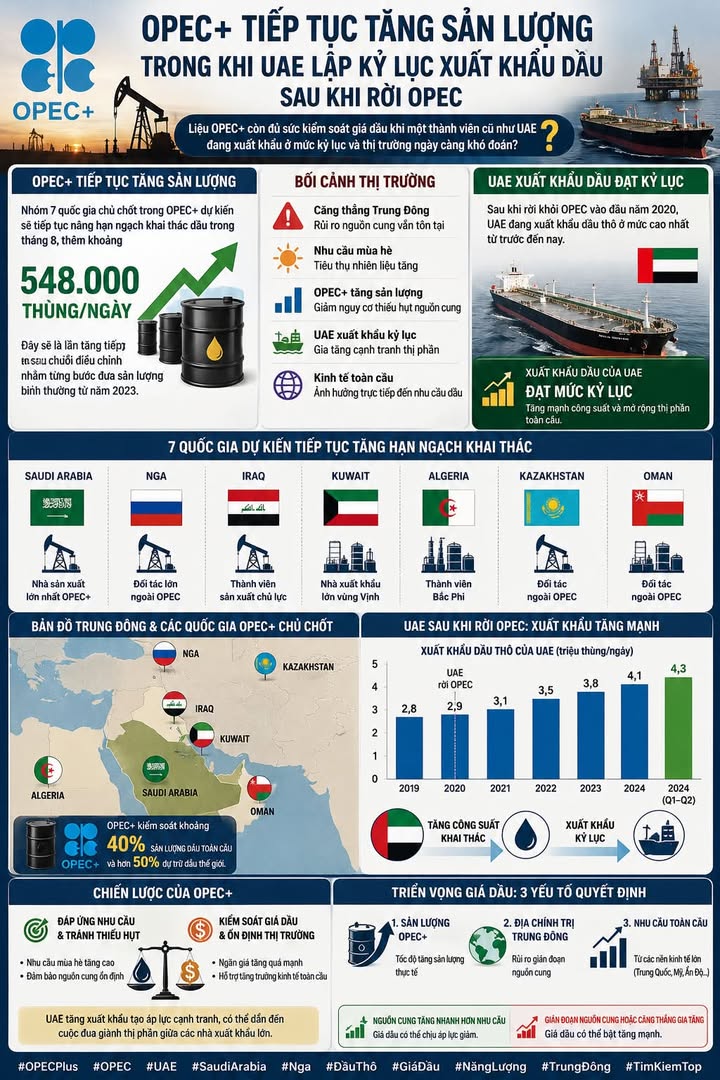
The seven key countries within OPEC+ are expected to collectively raise production quotas by approximately 548,000 barrels per day in August 2023, marking another step in the gradual restoration of production levels that were curtailed during 2023. This decision comes in the wake of heightened tensions in the Middle East, where recent US and Israeli strikes against Iran caused significant volatility in global oil markets.
According to sources familiar with the matter, the group—comprising Saudi Arabia, Russia, Iraq, Kuwait, Algeria, Kazakhstan, and Oman—is likely to formalize this agreement in the coming weeks. The incremental increase reflects a careful balancing act between meeting rising demand and preventing market oversupply that could depress prices.
Key Countries in the Production Increase
| Country | Role in OPEC+ |
|---|---|
| Saudi Arabia | Largest producer in OPEC+ |
| Russia | Major non-OPEC partner |
| Iraq | Core producing member |
| Kuwait | Major Gulf exporter |
| Algeria | North African member |
| Kazakhstan | Non-OPEC partner |
| Oman | Non-OPEC partner |
UAE's Record Exports Post-OPEC Exit
Simultaneously, the UAE is capitalizing on its departure from OPEC by achieving record oil export levels. This strategic move demonstrates the nation's determination to maximize its production and export capabilities to expand its international market share. The timing—immediately following its exit from OPEC—suggests a calculated strategy to operate with greater flexibility in the global marketplace.
The UAE's increased exports create additional competitive pressure on traditional producers within OPEC+. If this trend continues, the market could witness intensified competition for market share among major oil-exporting nations.
Factors Influencing the Global Energy Market
| Factor | Market Impact |
|---|---|
| Middle East Tensions | Persistent supply risks remain |
| Summer Demand | Increased fuel consumption |
| OPEC+ Production Increases | Reduced risk of supply shortages |
| UAE Record Exports | Heightened market share competition |
| Global Economy | Direct impact on oil demand |
Strategic Implications for OPEC+
The production increase reflects OPEC+'s dual strategic objectives: first, to meet rising consumption demands during the summer season while avoiding supply shortages; second, to prevent oil prices from escalating too sharply, which could reduce consumption and contribute to inflation in many economies.
However, the UAE's aggressive export strategy introduces a complicating factor. By maximizing production outside the OPEC framework, the UAE is demonstrating that some members may prioritize individual market interests over collective production management. This divergence could potentially weaken OPEC+'s traditional market influence.
Market Outlook and Price Predictions
Industry analysts suggest that oil prices in the coming months will depend on three primary factors: the actual pace of OPEC+ production increases, geopolitical developments in the Middle East, and demand patterns from major economies including China, the United States, and India.
Should production increases outpace demand growth, oil prices may face downward pressure. Conversely, any supply disruptions in the Middle East could trigger rapid price increases, potentially within short timeframes. The UAE's expanded production adds another variable to this equation, potentially creating a more competitive market environment.
Conclusion: A Shifting Global Oil Landscape
The simultaneous occurrence of OPEC+ production increases and the UAE's record exports signals a potentially transformative period for global oil markets. While traditional mechanisms of production management remain in place, the emergence of more aggressive independent strategies by key producers suggests a more competitive and potentially less predictable market environment.
As the energy landscape continues to evolve, the effectiveness of OPEC+ in maintaining market stability will be tested by the growing willingness of some producers to pursue individual strategies that may not align with collective interests. The coming months will likely reveal whether traditional production management frameworks can adapt to these new market dynamics or if we are witnessing the early stages of a fundamentally different approach to global oil production and distribution.