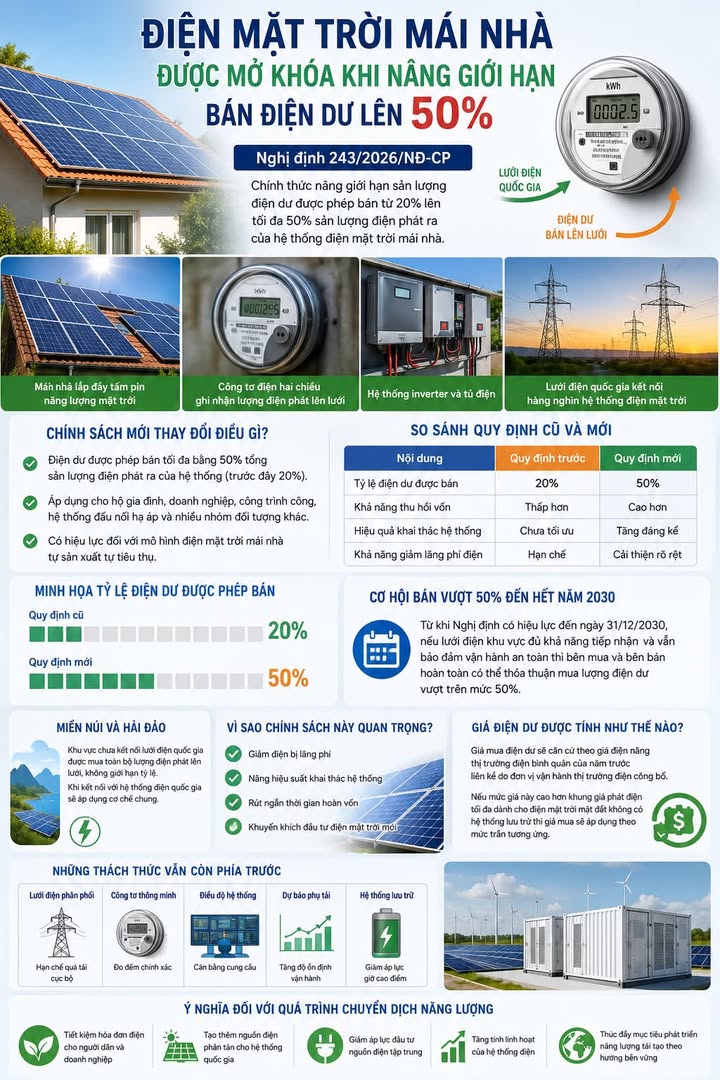
Vietnam's Rooftop Solar Sector Transforms as Government Raises Excess Electricity Sales Limit to 50%
In a landmark move that could reshape the nation's energy landscape, Vietnam has significantly expanded opportunities for rooftop solar power by increasing the limit on excess electricity sales from 20% to 50%. This policy shift, formalized through Decree 243/2026/NĐ-CP, marks one of the most significant developments in the country's renewable energy sector in recent years, potentially transforming millions of rooftops into "mini power plants" and revolutionizing electricity consumption patterns nationwide.
Understanding the Policy Shift
The newly implemented Decree 243/2026/NĐ-CP represents a fundamental change in how Vietnam approaches rooftop solar energy. Previously, households and businesses with solar installations could only sell back a maximum of 20% of the electricity their systems generated. The new regulation doubles this allowance, allowing producers to sell up to half of their generated electricity to the national grid.
This policy change effectively transitions rooftop solar from a primarily self-consumption model to a hybrid approach that combines self-consumption with grid contribution. The regulation applies to households, businesses, public facilities, and various low-voltage connection systems, making it broadly accessible across different sectors of society.
Comparing Old and New Regulations
The table below provides a clear comparison between the previous regulations and the new policy framework:
| Aspect | Previous Regulation | New Regulation (Decree 243) |
|---|---|---|
| Maximum excess electricity sales | 20% of total production | 50% of total production |
| Investment payback period | Longer | Shorter |
| System utilization efficiency | Suboptimal | Significantly improved |
| Electricity waste reduction | Limited | Markedly improved |
Visual representation of the policy change:
Previous Regulation:
████░░░░░░░░░░░░░░ 20%
New Regulation:
██████████░░░░░░░░ 50%
Flexible Framework for Excess Sales Beyond 50%
A particularly noteworthy aspect of the new policy is its flexibility regarding electricity sales beyond the 50% threshold. From the effective date of the decree until December 31, 2030, if the regional grid has sufficient capacity and can maintain safe operations, buyers and sellers may negotiate the purchase of excess electricity beyond the 50% limit.
This approach demonstrates a shift from rigid limitations to a more flexible management style based on the actual capacity of the electrical system. It acknowledges the dynamic nature of energy production and consumption while ensuring grid stability.
Special Provisions for Remote Areas
The policy includes special considerations for regions that have historically faced energy challenges. For mountainous, border, and island areas not yet connected to the national grid, the regulation is even more permissive: all electricity generated can be sold to the grid without percentage limitations.
When these areas eventually connect to the national grid system, they will transition to the standard regulatory framework. This provision aims to accelerate rural electrification and support development in remote regions through renewable energy.
Why This Policy Matters
The significance of this policy change cannot be overstated, particularly when considering the practical realities of solar energy production. Solar panels typically generate maximum power around midday, a period when:
- Household members are often at work or school
- Office buildings experience reduced activity during lunch breaks
- Many commercial establishments experience lower electricity consumption
Under the previous 20% limit, substantial amounts of electricity were effectively wasted during peak production hours. The new 50% allowance addresses this inefficiency by:
- Reducing electricity waste
- Improving system utilization efficiency
- Shortening investment payback periods
- Encouraging new solar energy investments
Pricing Mechanism for Excess Electricity
The decree establishes a market-based approach for pricing excess electricity. The purchase price will be determined based on the average market electricity price of the previous year, as published by the electricity market operator.
If this market price exceeds the maximum price cap for ground-mounted solar power without storage systems, the purchase price will apply the corresponding ceiling. This mechanism ensures that electricity prices more accurately reflect market conditions rather than remaining fixed for extended periods.
Challenges Ahead
While the policy opens significant opportunities, it also presents challenges that must be addressed to ensure successful implementation. The integration of hundreds of thousands of solar systems generating electricity simultaneously creates new requirements for the power sector:
| Infrastructure Need | Objective |
|---|---|
| Distribution grid upgrades | Prevent local overloading |
| Smart meter deployment | Ensure accurate measurement |
| System balancing capabilities | Maintain supply-demand equilibrium |
| Enhanced load forecasting | Improve operational stability |
| Energy storage systems | Reduce peak-hour pressure |
Implications for Vietnam's Energy Transition
This policy extends beyond simply helping consumers reduce electricity bills. It creates a distributed energy source that supplements the national grid system. As Vietnam's electricity demand continues to grow—driven by industrial development, AI data centers, and the broader electrification of the economy—efficiently utilizing millions of rooftops will:
- Reduce pressure on centralized power investments
- Increase system flexibility
- Promote sustainable renewable energy development
The policy aligns with Vietnam's broader energy transition goals and demonstrates a commitment to developing a more sustainable and resilient energy system. By empowering consumers to become both energy consumers and producers, the initiative fosters a more democratic and participatory approach to energy generation.
As Vietnam continues to navigate its energy transition, the expanded rooftop solar policy represents a significant step toward a more sustainable and efficient energy future. The successful implementation of this policy will depend on continued investment in grid infrastructure, technological innovation, and supportive regulatory frameworks that balance economic incentives with grid reliability and sustainability objectives.