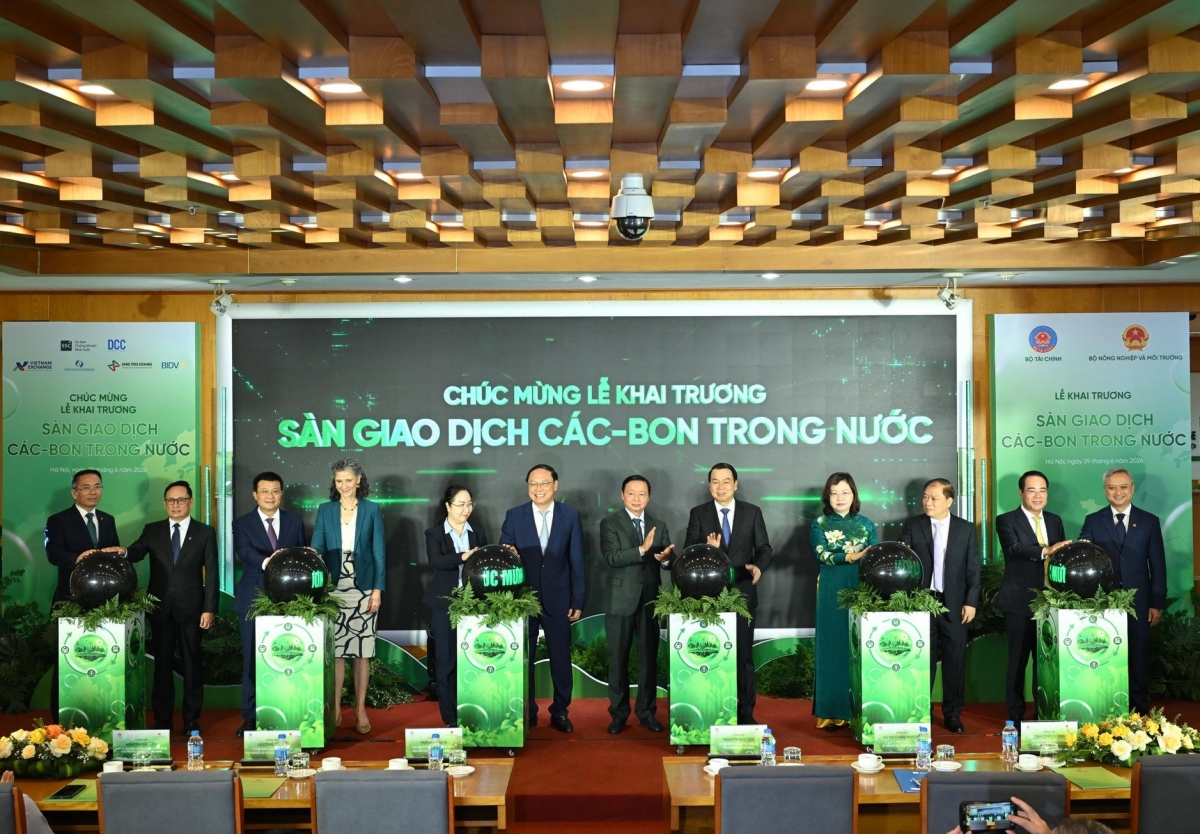
The Future of Vietnam's Carbon Market: Insights from the First Trading Session in Hanoi
June 29, 2026, marked a significant milestone in Vietnam's energy transition journey as the Carbon Exchange officially launched its pilot operations and recorded the first greenhouse gas emission allowance trades. Although the initial trading price of approximately 130,000 - 136,000 Vietnamese Dong per ton of CO2 equivalent (CO2e) was modest, its significance far exceeded that of a typical financial transaction.
For the first time, greenhouse gas emissions in Vietnam began to be priced on an organized market, opening a new chapter in the country's journey to implement emission reduction commitments made at COP26 and move toward the goal of carbon neutrality by 2050.
Background of Vietnam's Carbon Market Formation
As one of the countries most severely affected by climate change, Vietnam has made strong commitments to reduce greenhouse gas emissions. To realize these commitments, establishing a national carbon market has become one of the most important solutions.
The preparation process for Vietnam's carbon market began several years ago with the issuance of the amended Environmental Protection Law (2020) and various guiding decrees. However, it wasn't until mid-2026, after numerous adjustments and improvements to the legal framework, that the carbon exchange officially began operations.
Details of the First Trading Session
The first trading session took place in Hanoi on the morning of June 29, 2026, with participation from 15 enterprises, primarily major energy, manufacturing, and service corporations. The total trading volume reached 50,000 tons of CO2e, with prices ranging from 130,000 to 136,000 VND per ton.
According to Mr. Nguyen Van Binh, Chairman of the State Securities Commission, the first trading session exceeded expectations, demonstrating that the market is ready for official transactions in the near future. "We are very pleased to see significant interest from the business community. This is not just a financial market but also an important tool to implement national commitments on emission reduction," Mr. Binh emphasized.
Enterprises participating in the first trading session included Vietnam Electricity (EVN), Vietnam Oil and Gas Group (PetroVietnam), Military Industry-Telecom Group (Viettel), and several large manufacturing companies such as Vinamilk and Masan Group.
Significance of the Carbon Market for Vietnam
The carbon market is viewed as an effective market-based economic instrument to reduce greenhouse gas emissions. Instead of using rigid administrative regulations, the carbon market creates a mechanism to encourage enterprises to voluntarily reduce emissions or invest in clean technology to save on allowance purchase costs.
Ms. Tran Thi Thu Hang, an environmental expert from the Energy Institute, commented: "The establishment of a carbon market in Vietnam not only helps the country achieve emission reduction targets but also opens up opportunities to attract investment in green technology projects, creating a sustainable circular economy ecosystem."
Furthermore, the carbon market enhances Vietnam's position in the international community, demonstrating responsibility toward climate change and creating conditions for participation in regional and global carbon markets.
Comparison with International Carbon Markets
Compared to developed carbon markets worldwide, Vietnam's carbon market is still in its initial stages. However, in terms of formation speed, Vietnam is evaluated as faster than many countries in the region.
| Feature | Vietnam | Thailand | Indonesia | EU |
|---|---|---|---|---|
| Start Year | 2026 | 2025 | 2024 | 2005 |
| CO2e Price (USD/ton) | 5-6 | 8-10 | 7-9 | 80-100 |
| Scope of Application | Voluntary | Mandatory for certain sectors | Mandatory for large corporations | Mandatory across the board |
| Total First Year Volume | 50,000 tons | 200,000 tons | 500,000 tons | 2 billion tons |
Mr. Le Hoang Anh, an environmental finance expert, noted: "Carbon prices in Vietnam are currently lower than the global average, reflecting the early development stage of the market. However, with growth potential and strong government commitments, carbon prices in Vietnam could increase significantly in the coming years."
Future Challenges and Opportunities
Despite the favorable start, Vietnam's carbon market still faces numerous challenges. First is the issue of transparency and accuracy in emission reporting and verification. Second is the shortage of experts capable of pricing and trading carbon derivative products. Finally is the establishment of an effective Monitoring, Reporting, and Verification (MRV) system.
However, these challenges also present numerous opportunities for consulting firms, technology companies, and financial institutions. Companies providing emission monitoring technology solutions, independent verification firms, and investment funds in emission reduction projects will all have strong growth opportunities.
According to the plan, during the 2026-2030 period, Vietnam's carbon market will operate on a voluntary basis, focusing on large enterprises and emission reduction projects. The 2031-2035 phase will expand to a mandatory mechanism for some energy-intensive industries. By 2040, Vietnam expects its carbon market to operate fully and connect with regional markets.
Conclusion
The first trading session of the Carbon Exchange marks an important step in Vietnam's energy transition journey and implementation of emission reduction commitments. Although there are still challenges to overcome, the carbon market promises to become a crucial pillar in the country's sustainable green economy.
The establishment and development of the carbon market is not only an environmental requirement but also an opportunity for Vietnam to restructure its economy, promote innovation, and enhance its competitive position internationally. In the context of increasingly severe climate change, this is truly a correct and urgent direction.
Hashtag: #CarbonMarket #EnergyTransition #EmissionReduction #GreenEconomy #ClimateChange #Vietnam2050