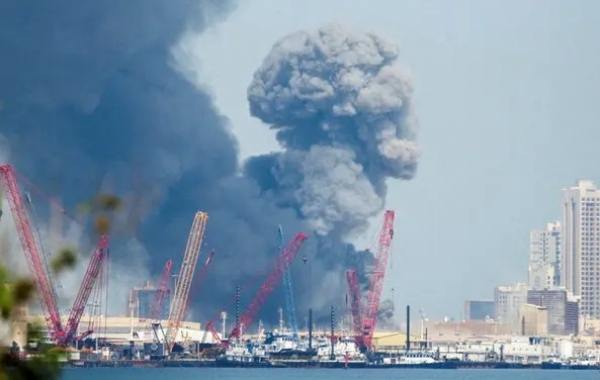
Middle East Escalates: Iran Launches Strikes Against US-Linked Targets
In a significant escalation of tensions across the Middle East, Iran has conducted military strikes against targets reportedly connected to US forces, marking a new development in the complex geopolitical relationship between the two nations and the broader regional dynamics.
Escalating Tensions in the Middle East
The Middle East continues to be a volatile hotspot with increasingly complex developments, where political and military tensions constantly threaten to erupt into large-scale conflicts. Against this backdrop, the decades-long adversarial relationship between Iran and the United States has particularly intensified since the US withdrawal from the 2018 nuclear agreement and the reimposition of economic sanctions.
According to Iran's Ministry of Defense, the attacks were conducted in response to US activities in the region. The targeted facilities were identified as military bases and infrastructure linked to US forces in Iraq and Syria.
Details of the Attack
The strikes occurred on the morning of June 28, utilizing both ballistic missiles and unmanned aerial vehicles (drones). Iran's Ministry of Defense described these actions as "self-defense" against perceived threats from the US and its allies.
Iran claimed that the attacks targeted "terror sponsors" in the region, implicitly referring to groups supported by the United States. US sources reported that defense systems intercepted several missiles and drones, though some facilities still sustained damage.
International Reactions
United States: The US Department of Defense strongly condemned the attacks, labeling them as "provocative" and "destabilizing." A Pentagon spokesperson stated that the US possesses sufficient defensive capabilities and will respond appropriately.
Iraq: The Iraqi government expressed deep concern about the attacks, emphasizing that Iraq does not wish to become a battleground for great power rivalries.
United Nations: The UN Secretary-General called on all parties to remain calm, avoid further escalation, and seek diplomatic solutions.
Russia and China: These two major powers urged de-escalation and suggested that the US should reconsider its policy toward Iran.
Historical Context of Iran-US Relations
The relationship between Iran and the US has experienced numerous fluctuations since the 1979 Islamic Revolution. Relations reached their lowest point after the US unilaterally withdrew from the nuclear agreement in 2018 and reinstated economic sanctions.
The following table summarizes key events in Iran-US relations in recent years:
| Timeline | Major Event | Impact |
|---|---|---|
| 2018 | US withdraws from JCPOA nuclear agreement | Increased tensions, Iran begins exceeding nuclear limits |
| 2019 | Attack on Aramco oil facilities in Saudi Arabia | US blames Iran, Iran denies involvement |
| 2020 | US kills General Soleimani | Iran retaliates with missiles at US base in Iraq |
| 2022 | Nuclear negotiations deadlock | Tensions continue to escalate |
| 2023 | Attack on Israel from Iranian territory | US increases military presence in region |
| 2024 | Attack on US-linked targets | New hotspot in Middle East |
Predictions for Future Developments
Security analysts predict that tensions in the Middle East are likely to continue escalating in the coming months. The US may increase its military presence in the region, while Iran could continue with retaliatory actions.
Regional stakeholders, including Israel, Saudi Arabia, and Gulf states, will likely attempt to minimize conflict while simultaneously preparing for worst-case scenarios.
Impact on Global Energy Security
The Middle East is a critical region for global oil supplies. Military tensions in the area could affect oil production, causing fluctuations in global energy prices.
International oil companies have begun considering evacuation plans for personnel in high-risk areas. The global oil market reacted quickly to news of the attacks, with prices showing slight increases.
Conclusion
Iran's June 28 attack on US-linked targets represents a concerning escalation in an already unstable Middle East. The current situation demands wisdom and restraint from all involved parties, along with diplomatic efforts to avoid a large-scale conflict that could have severe consequences for both the region and the world.
According to analysts, a long-term solution to the Middle East situation requires a multilateral approach focused on dialogue and cooperation rather than confrontation. However, given the current political landscape, this path remains challenging.