Oil and Wastewater: The Hidden Connection to Induced Seismicity
If wastewater from oil and gas operations can awaken dormant fault lines, are we calculating the true cost of a barrel of oil correctly?
The Alarming Picture
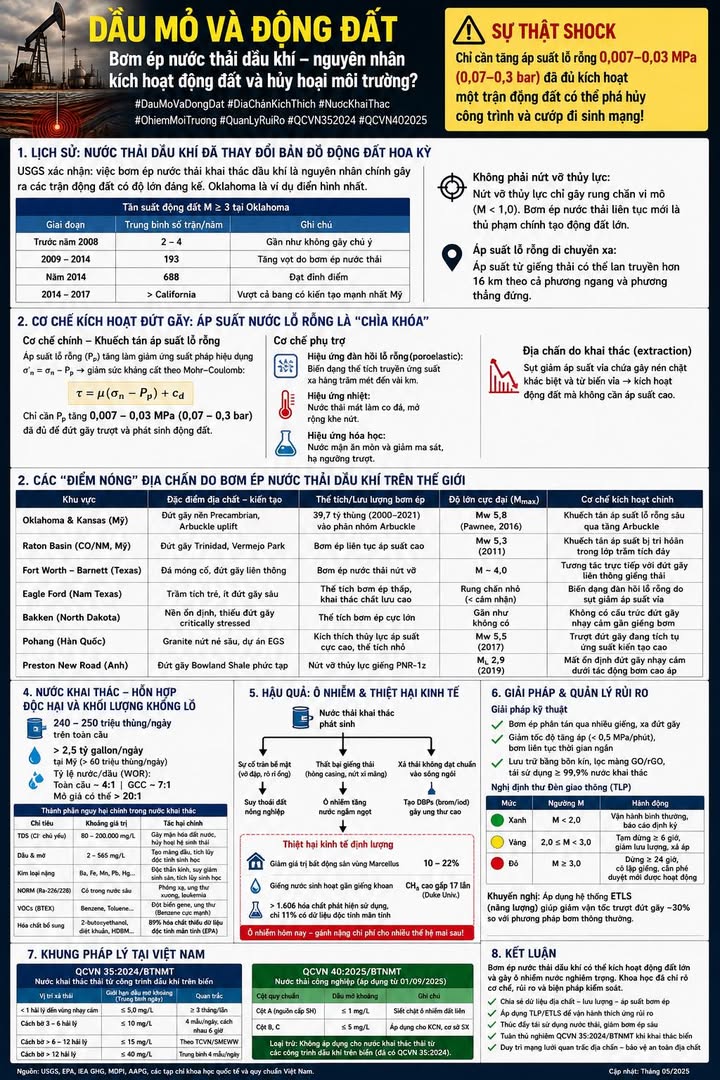
Induced seismicity refers to earthquakes caused by human activities, particularly related to fluid injection deep underground. Since the 1960s at the Rocky Mountain Arsenal near Denver, Colorado, scientists have documented the correlation between wastewater injection and local seismic events.
The most striking case is Oklahoma. Prior to 2008, this state experienced only about 2-4 earthquakes of magnitude 3.0 or greater annually. However, between 2009 and 2014, the number increased to an average of 193 earthquakes per year, reaching 688 in 2014 alone.
| Region | Primary Phenomenon | Maximum Recorded Magnitude | Year |
|---|---|---|---|
| Oklahoma and Kansas, USA | Wastewater injection into Arbuckle formation | Mw 5.8 | 2016 (Pawnee) |
| Raton Basin, USA | High-pressure wastewater injection | Mw 5.3 | 2011 |
| Pohang, South Korea | Geothermal hydraulic stimulation | Mw 5.5 | 2017 |
| Preston New Road, UK | Hydraulic fracturing of Bowland Shale | ML 2.9 | 2019 |
| Kon Plông, Vietnam | Hydroelectric reservoir-induced seismicity | M ~5.0 | Recent |
The Culprit Isn't Just Hydraulic Fracturing
A common misconception is blaming all seismic activity on hydraulic fracturing. Research from the USGS indicates that hydraulic fracturing typically only causes very small seismic events. The greater risk lies in long-term, large-scale wastewater injection from oil and gas operations.
The core mechanism is the increase in pore pressure within rock formations. When wastewater is pumped deep underground, this pressure reduces the frictional forces holding fault planes together. If a fault is already under stress, even a small change can cause it to slip suddenly, generating an earthquake.
| Triggering Factor | Impact |
|---|---|
| Increase in pore pressure | Weakens the clamping force on faults |
| Continuous injection | Accumulates pressure over extended periods |
| Sensitive fault zones | Prone to slipping with minimal stress changes |
| High-salinity wastewater | Corrodes and weakens geological materials |
| Temperature differentials | Causes rock contraction and fracturing |
Produced Water: More Than Just Contaminated Water
Produced water is the largest waste stream in the oil and gas industry. Globally, approximately 240-250 million barrels of wastewater are generated daily. The water-to-oil ratio can reach 4 barrels of water per barrel of oil, and in mature fields, it can be as high as 10-20 barrels of water per barrel of oil.
| Hazardous Components | Environmental and Health Risks |
|---|---|
| Total Dissolved Solids (TDS) | Soil and freshwater salinization |
| Oil and grease | Reduces oxygen levels in water bodies |
| Barium, iron, manganese, lead, mercury | Bioaccumulation, neurotoxicity |
| Radium-226 and Radium-228 | Long-term radiation risks |
| Benzene, Toluene, Xylene (BTX) | Associated with toxicity and cancer |
| H2S (Hydrogen sulfide) | Asphyxiation, respiratory distress, death at high concentrations |
| Methane | Explosion hazard and increased greenhouse gas emissions |
The Impacts Extend Beyond Subsurface
Wastewater can cause contamination through various pathways including containment pond failures, pipeline leaks, faulty disposal wells, compromised wellbore cement, or improper discharge into waterways.
| Contamination Pathway | Consequences |
|---|---|
| Surface leaks | Agricultural land degradation |
| Failed casing in disposal wells | Groundwater aquifer contamination |
| Open containment ponds | Methane evaporation, chemical spills |
| Discharge into rivers and streams | Formation of toxic disinfection byproducts |
| Road spreading of wastewater | Accumulation of salts, heavy metals, and NORM |
Studies in the Marcellus region show that private well owners near oil and gas extraction areas could experience 10-22% property value loss due to concerns about groundwater contamination.
Vietnam's Situation: Different from the US, But Not Without Risks
In Vietnam, there is currently no scientific evidence linking oil and gas fluid injection activities to induced seismicity similar to what has been observed in the United States. Induced seismicity events have primarily been associated with hydroelectric reservoirs such as Hoa Binh, Song Tranh 2, Son La, and Kon Plông.
In oil and gas operations, the Bach Ho field has used seawater injection since 1987 to maintain reservoir pressure and enhance oil recovery, which differs from the large-scale deep wastewater injection model seen in Oklahoma. The main challenges at Bach Ho involve early water breakthrough, increasing water cut, and optimizing flow in fractured basement rock.
The Need for Stricter Regulatory Frameworks
| Solution | Objective |
|---|---|
| Distribute injection across multiple wells | Avoid localized pressure buildup |
| Reduce pressure increase rate | Limit sudden fault slippage |
| Replace open ponds with closed tanks | Reduce leaks and methane emissions |
| Reuse produced water | Reduce need for wastewater disposal |
| Implement Traffic Light Protocol (TLP) | Pause or reduce operations during seismic events |
| Public pressure and flow rate data | Enhance community monitoring capabilities |
Conclusion
The story of oil and earthquakes is no longer a distant hypothesis. Evidence from Oklahoma, Texas, South Korea, and the United Kingdom demonstrates that when wastewater is pumped deep underground, humans can inadvertently activate fault lines in extremely sensitive states.
For Vietnam, the risk profile in oil and gas currently differs from North America, but the international lessons are clear. To develop energy safely, we cannot only calculate oil production volumes but must also account for wastewater, subsurface pressure, toxic substances, environmental costs, and long-term seismic safety.
The true cost of energy must include all these factors to ensure sustainable development for future generations.