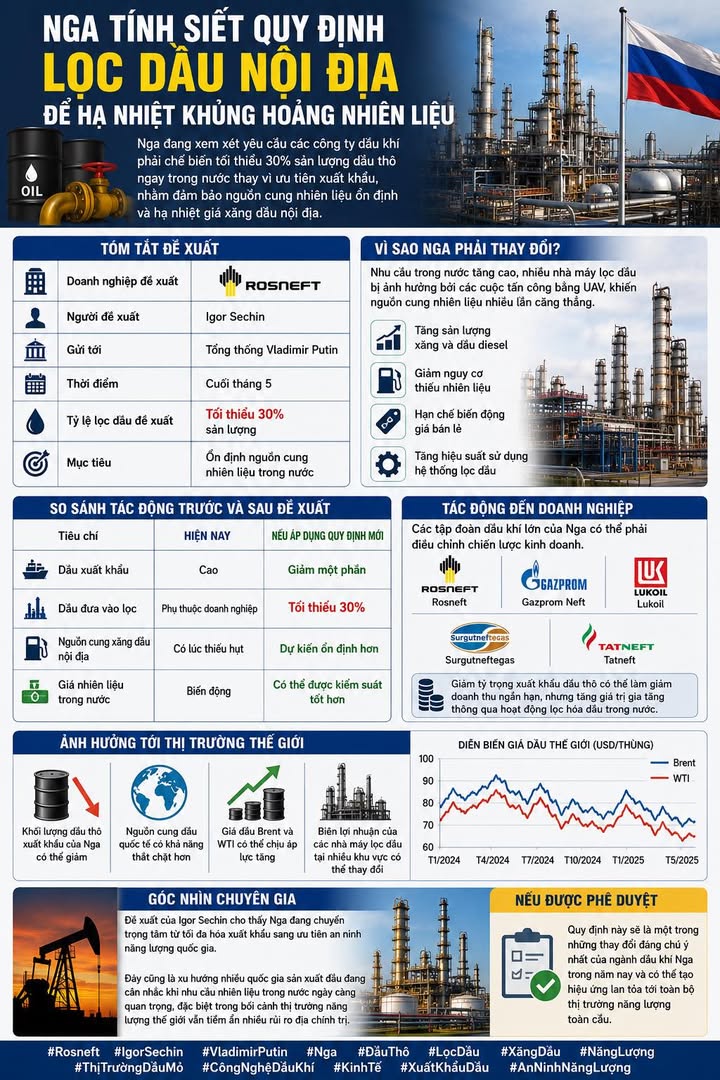
Russia Considers Mandatory Domestic Oil Refining Requirements to Address Fuel Crisis
In a move that could significantly reshape global energy markets, Russia is contemplating a major policy shift that would require oil companies to refine a substantial portion of their production domestically. The proposal, submitted by Igor Sechin, CEO of Rosneft, to President Vladimir Putin in late May, aims to address persistent fuel shortages and price volatility within Russia by mandating that at least 30% of crude oil output be processed in domestic refineries rather than exported.
Proposed Regulation: A Game Changer for Russia's Oil Sector
The proposal represents a fundamental shift in Russia's energy strategy, moving away from a model that prioritized crude oil exports toward one that emphasizes domestic refining capacity and fuel security. If implemented, this requirement would force major Russian oil producers to reallocate significant portions of their production from export markets to domestic refining operations.
The timing of this proposal is particularly noteworthy, as Russia continues to grapple with localized fuel shortages and mounting pressure on domestic fuel prices. The country's energy infrastructure has faced additional challenges due to drone attacks on several refineries, further complicating the supply situation.
| Summary of Russia's Proposed Oil Refining Regulation | |
|---|---|
| Proposing Company: | Rosneft |
| Proposal Author: | Igor Sechin, CEO |
| Submitted To: | President Vladimir Putin |
| Submission Date: | Late May 2023 |
| Minimum Domestic Refining Requirement: | 30% of production volume |
| Primary Objective: | Stabilize domestic fuel supply |
Drivers Behind the Policy Shift
For decades, Russia has relied heavily on crude oil exports as a primary source of foreign exchange revenue. However, several converging factors have made this approach increasingly unsustainable:
- Rising domestic fuel consumption driven by economic growth and increased vehicle ownership
- Geopolitical tensions affecting export logistics and market access
- Physical damage to refineries from drone attacks and other security incidents
- Seasonal demand fluctuations leading to periodic fuel shortages
- Price volatility affecting domestic consumers and industrial users
The proposed policy directly addresses these challenges by redirecting crude oil from export markets to domestic refining capacity. This shift would theoretically increase the production of gasoline and diesel, reduce the risk of fuel shortages, limit retail price fluctuations, and improve the overall efficiency of Russia's refining system.
Comparative Analysis: Current vs. Proposed Regulatory Environment
| Criteria | Current System | With New Regulation |
|---|---|---|
| Crude Oil Exports | High volume prioritized | Reduced volume |
| Domestic Refining Input | Company-dependent decisions | Mandatory minimum 30% of production |
| Domestic Fuel Supply | Periodic shortages reported | Expected stabilization |
| Fuel Pricing | Significant volatility | Improved price control |
Impact on Russian Oil Companies
The implementation of such a regulation would necessitate significant strategic adjustments for Russia's major oil producers, including:
- Rosneft: As Russia's largest oil producer and the company proposing the regulation, Rosneft would likely be positioned to benefit from increased refining operations, though it would also face the challenge of redirecting substantial export volumes.
- Gazprom Neft: The oil subsidiary of state gas giant Gazprom would need to expand its refining capacity or modify its production mix to comply with the new requirements.
- Lukoil: Russia's second-largest privately-owned oil company would need to reevaluate its export strategies and potentially increase investment in domestic refining infrastructure.
- Surgutneftegas: Known for its conservative approach, this company would face particular challenges in adapting its business model to accommodate higher domestic refining requirements.
- Tatneft: The Tatarstan-based oil company would need to balance its existing refining operations with the new mandatory domestic processing requirements.
While reducing crude oil exports could initially decrease short-term international revenue, companies might benefit from increased value-added activities through expanded domestic refining operations. The refining process typically generates higher profit margins than simply exporting crude, particularly when integrated with domestic distribution networks.
Global Market Implications
A decision by Russia to mandate domestic refining of 30% of its oil production would have far-reaching consequences for global energy markets:
- Reduced Crude Exports: Russia is one of the world's largest oil exporters, and a significant reduction in available crude for international markets could tighten global supply.
- International Price Pressure: With potentially less Russian crude available on global markets, prices for benchmarks like Brent and WTI could face upward pressure, especially if global demand remains robust.
While crude exports might decrease, Russia could potentially increase exports of refined products like gasoline and diesel, altering global product flows and pricing. - Refining Margin Changes: The balance between crude and refined product markets could shift, potentially impacting refining margins in other regions.
Importers dependent on Russian crude would need to seek alternative supplies, potentially accelerating shifts in global trade patterns.
Expert Analysis and Strategic Implications
Energy analysts view the proposal as indicative of a broader strategic shift in Russia's approach to energy security. "This represents a move from a purely export-oriented model to one that prioritizes domestic energy security," explains Dr. Elena Petrova, an energy markets specialist at the Moscow Institute of Energy Policy. "In an increasingly uncertain geopolitical environment, ensuring domestic fuel supplies has become a national security priority."
The proposal also reflects a global trend among oil-producing nations to reassess their energy strategies. "Many oil-rich countries are recognizing the economic and strategic benefits of developing domestic refining capacity rather than remaining solely commodity exporters," notes James Mitchell, senior analyst at the Global Energy Research Institute. "Russia's potential move could accelerate this trend worldwide."
If approved by President Putin, this regulation would mark one of the most significant transformations of Russia's oil sector in recent years. The policy could create ripple effects throughout the global energy complex, potentially influencing everything from crude prices to refining margins and regional fuel security strategies.
Future Outlook and Potential Implementation
While the proposal has been submitted to President Putin, its implementation timeline remains uncertain. The Russian government would likely need to:
- Conduct thorough economic impact assessments
- Develop implementation guidelines and transition periods
- Address potential concerns from international trading partners
- Consider regional variations in refining capacity and demand
- Establish mechanisms to monitor compliance and effectiveness
The coming months will be critical in determining whether this proposal moves from concept to policy. Should it be implemented, Russia's oil sector would undergo a fundamental transformation, with significant implications for both domestic energy security and global oil markets.
As the world continues to navigate the complex energy transition and geopolitical uncertainties, Russia's potential pivot toward domestic refining could reshape global energy flows and set a precedent for other resource-rich nations considering similar strategic shifts.