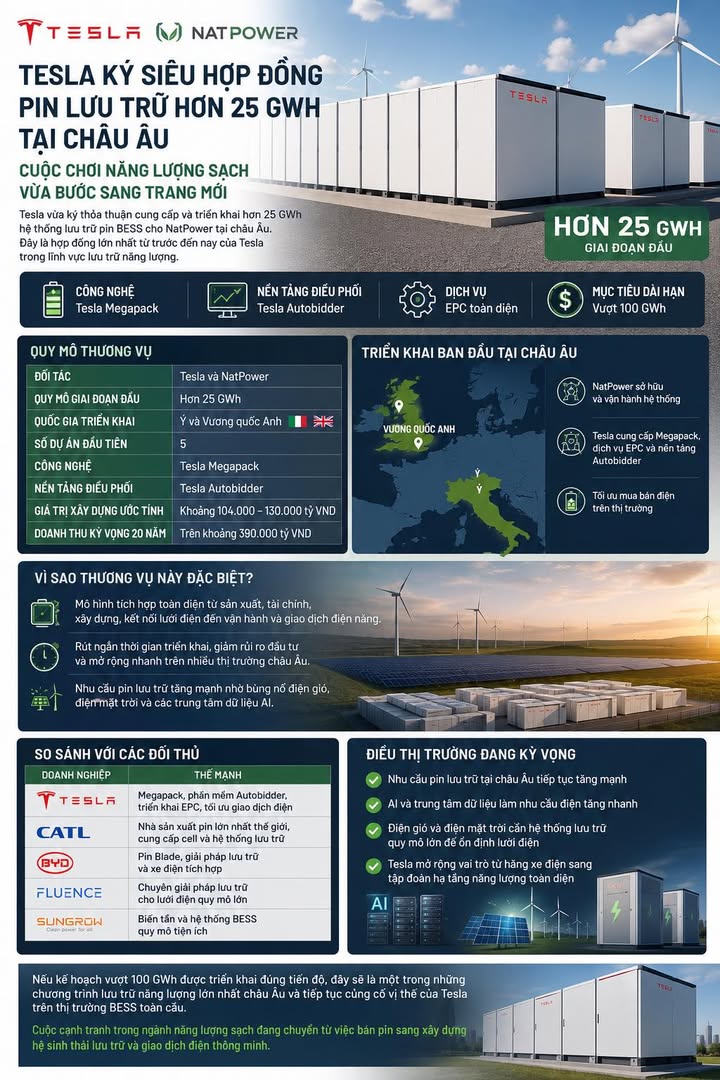
Terraforms European Energy Landscape with Massive 25+ GWh Battery Storage Deal
In a move that could fundamentally reshape the European energy market, Tesla has announced one of the largest energy storage agreements in history, partnering with NatPower to deploy over 25 GWh of battery energy storage systems (BESS) across Europe. This landmark deal extends beyond simple hardware provision, encompassing a comprehensive collaboration that includes equipment, construction, energy coordination software, and long-term revenue assurance mechanisms.
The agreement marks a significant milestone in the transition toward renewable energy infrastructure and positions Tesla as a major player in the global energy storage sector, potentially outpacing numerous competitors in this rapidly evolving field.
Unprecedented Scale and Scope of Collaboration
The initial phase of this ambitious partnership will see the deployment of five pioneering projects in Italy and the United Kingdom. Under this arrangement, NatPower will retain ownership and operational responsibilities for the energy storage systems, while Tesla will supply its Megapack battery units, provide Engineering, Procurement, and Construction (EPC) services, and implement its proprietary Autobidder platform for optimizing electricity trading on the market.
What distinguishes this agreement from previous energy storage contracts is its comprehensive nature. Rather than functioning as isolated transactions, Tesla and NatPower are establishing an integrated model that spans production, financing, construction, grid interconnection, operations, and energy trading. This holistic approach aims to reduce implementation timelines, mitigate investment risks, and enable rapid expansion across multiple European markets.
A Vision Beyond 25 GWh
The 25+ GWh initial commitment represents merely the first phase of a much more extensive plan. Both companies have articulated a vision to eventually surpass 100 GWh of deployed battery storage capacity throughout Europe. The total estimated construction value for this expanded initiative ranges from approximately 104,000 to 130,000 trillion Vietnamese Dong (roughly $4.4-5.5 billion USD), with projected revenues exceeding 390,000 trillion VND (approximately $16.6 billion USD) over a 20-year period.
This long-term strategic alignment underscores confidence in the growing demand for energy storage solutions across the continent and highlights the economic viability of large-scale renewable energy integration.
| Tesla-NatPower Partnership: Key Details | |
|---|---|
| Partners | Tesla and NatPower |
| Initial Phase Capacity | Over 25 GWh |
| Deployment Countries | Italy and United Kingdom |
| Initial Project Count | 5 |
| Technology | Tesla Megapack |
| Coordination Platform | Tesla Autobidder |
| Estimated Construction Value | 104,000 to 130,000 trillion VND |
| 20-Year Projected Revenue | Over 390,000 trillion VND |
Why This Deal Represents a Paradigm Shift
Historically, energy storage projects have predominantly been executed on a country-by-country basis, often as standalone initiatives. The Tesla-NatPower partnership introduces a transformative integrated model that encompasses the entire value chain—from manufacturing and financing to construction, grid connectivity, operations, and energy trading.
This integrated approach offers several advantages:
- Accelerated Deployment: Streamlined processes reduce time-to-market for energy storage projects
- Reduced Risk: Comprehensive planning and execution minimize investment uncertainties
- Scalability: The model can be rapidly replicated and expanded across multiple European markets
- Optimized Performance: Unified systems enable better coordination and efficiency across the energy ecosystem
Several factors are converging to drive unprecedented demand for large-scale energy storage solutions. The explosive growth of wind and solar power generation, coupled with the rising energy requirements of artificial intelligence and data centers, has created an urgent need for grid-scale storage systems capable of managing variable renewable energy output.
Energy storage facilities of this magnitude can store excess electricity generated during periods of high renewable production and discharge it back to the grid during peak demand periods or when renewable generation is insufficient. This capability is essential for maintaining grid stability as European nations transition toward cleaner energy sources.
Competitive Landscape in Energy Storage
The energy storage market has attracted numerous players, each with distinct strengths. Tesla's comprehensive approach differentiates it from competitors who may focus solely on specific components of the energy storage value chain.
| Company | Competitive Strengths |
|---|---|
| Tesla | Megapack technology, Autobidder software, EPC capabilities, electricity trading optimization |
| CATL | World's largest battery manufacturer, provides cells and complete storage systems |
| BYD | Blade battery technology, integrated energy storage and electric vehicle solutions |
| Fluence | Specialized in large-scale grid storage solutions |
| Sungrow | Power conversion systems and utility-scale BESS solutions |
Tesla's competitive advantage extends beyond hardware to include sophisticated software capabilities, comprehensive service offerings, and an integrated ecosystem approach. The company's Autobidder platform, for instance, leverages artificial intelligence to optimize energy trading strategies, maximizing revenue for storage system operators.
Market Implications and Future Outlook
The European energy storage market is experiencing unprecedented growth, driven by several key factors:
- Continued strong demand for energy storage solutions across the continent
- Rapid expansion of AI and data centers creating substantial new electricity demand
- Increasing penetration of wind and solar power requiring large-scale storage for grid stability
- Tesla's evolution from electric vehicle manufacturer to comprehensive energy infrastructure provider
If the planned expansion beyond 100 GWh proceeds according to schedule, this initiative will rank among the most extensive energy storage programs in European history. The agreement signals a broader shift in the clean energy industry's competitive landscape, moving beyond simple hardware sales toward the development of intelligent energy storage and trading ecosystems.
For Tesla, this partnership represents a strategic diversification beyond its automotive business, reinforcing the company's position as a vertically integrated clean energy provider. For NatPower and European utilities, the collaboration offers a pathway to implementing large-scale renewable energy integration while maintaining grid reliability and optimizing economic returns.
As European nations intensify their efforts to decarbonize energy systems and meet ambitious climate targets, partnerships of this scale will become increasingly essential. The Tesla-NatPower alliance may well serve as a model for future energy storage deployments, demonstrating how comprehensive collaboration between technology providers and energy companies can accelerate the transition toward a sustainable energy future.